
Cell Phones Bans Are Here, and People Are Growing to Like Them
Two and a half years ago, we surveyed parents and Americans on a hypothetical cell phone ban in schools. Some trailblazing states were just starting to crack down on phones in class, and we wanted to test the waters with the general public.
Well, to quote Malcolm in the Middle, “the future is now, old man.”
According to EdWeek’s running tally, 39 states and D.C. now have restrictions in place to ban or limit cell phones in school. Even more states encourage districts to restrict cell phones, though they don’t require it. Several of the newly-minted policies go into effect just in time for the upcoming school year.
We have a front row seat to the cell phone ban experiment, as America makes a concerted effort to rewrite the relationship between kids and technology. So, what does America think?
Timely for our line of inquiry, Pew Research just released new survey findings. Over three-fourths of Americans (77%) support banning cell phones in class. Only 18% are opposed. On top of that, support has increased by 9 points since just two years ago in 2024. There’s a clear direction to this trend.
Of course, not every cell phone restriction is created equal. Banning cell phones in class is a very different policy from banning cell phones during the entire school day, also known as a “bell-to-bell” cell phone ban. That means students can’t access their phones until they leave school at the end of the day, including during recess and passing periods—a policy adopted by a full 30 states according to EdWeek.
Bell-to-bell cell phone bans are not as unanimously supported. Pew’s results show that 48% of Americans support banning phones for the entire school day, and 43% oppose this type of ban. In other words, the country is split on the issue.
But we can observe a striking trend. In 2024, the majority of Americans opposed a bell-to-bell cell phone ban in schools (36% supported and 53% opposed). Just two years later, public opinion has shifted by more than 10 points in favor of cell phone bans. This is the first time that more Americans support than oppose a full school day cell phone ban (48% support and 43% oppose).
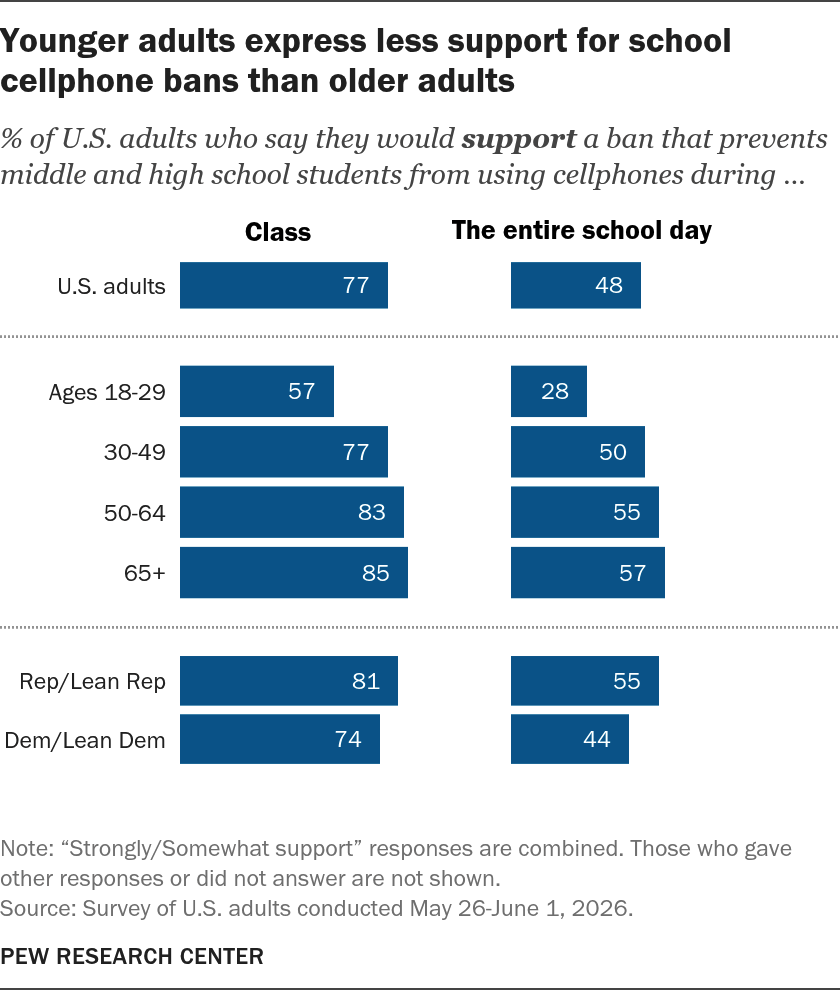
Of course, there is some variation among different demographic groups. Younger adults (18-29) tend to be less supportive of banning cell phones in schools. That makes sense to me (writing as a class of 2019 high school grad), as our generation had the most access to cell phones while we were in school. It feels odd and a bit uncomfortable to contemplate having your phone taken away, particularly for the entire school day. Only 28% of adults ages 18-29 support a bell-to-bell ban. However, a majority of every age group supports banning cell phones during class.
Cell phone restriction largely seems to be a bipartisan issue. Both Republicans and Democrats show strong support for in-class cell phones bans. In general, Republicans favor banning cell phones a bit more than their Democrat counterparts.

With policies and opinions shifting so quickly and strongly in favor of banning cell phones in schools, it certainly feels like we may be living through an important change in cultural norms around cell phone use—especially kids’ cell phone use. The invention of the cell phone took our society by storm, and only now are we decisively readjusting to its impact on education.
Is it too soon to predict how this story ends? Most likely, yes. But the change between 2024 and 2026—both in terms of legislative change and public opinion—suggests that we’ve firmly started down a certain pathway.
This was originally published to our Substack.
Latest from the Blog
-

Students with Disabilities More Represented in School Choice
New research co-authored by EdChoice researchers finds that students with disabilities participate in private school choice programs at higher rates than in public schools, challenging common assumptions about educational choice.
-

The Impossible Standard for ESAs: Zero Misuse
EdChoice’s Marty Lueken explains why ESA programs need strong oversight without sacrificing families’ access to educational opportunities.
-

New Report: Educational Freedom Grew and Test Scores Improved
Arkansas’s educational choice program got bigger, and the average test performance of the students got better.