
School choice allows public education funds to follow students to the schools or services that best fit their needs —whether that’s to a public school, private school, charter school, home school or any other learning environment families choose. Watch this video to see how an educational choice system works.
What is School Choice?

Types of School Choice
There are more than you might think. School choice encompasses much more than just school vouchers or charter schools. Check out our Types of School Choice page to learn more about how different educational choice options are funded and how they work for families.
-
Education Savings Accounts
Learn More -
School Vouchers
Learn More -
Tax-Credit ESAs
Learn More -
Tax-Credit Scholarships
Learn More -
Individual Tax Credits & Deductions
Learn More -
Refundable Tax Credits
Learn More -
Other
Learn More
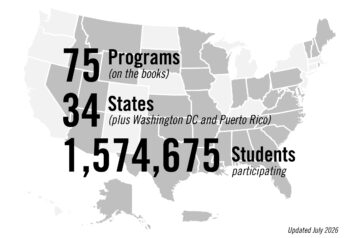
School Choice Across the United States
View All ProgramsBy the Numbers
Universal School Choice
Milton and Rose Friedman envisioned a future where every family could choose the learning environment that best fits their child. Achieving that vision requires more than simply creating school choice programs. A truly universal program must meet three standards:
All Students — Every student is eligible.
All Options — Families have broad flexibility in how they may use education funds.
All Dollars — Programs are funded through predictable, sustainable revenue streams.
School Choice in America Dashboard
Which states have which types of school choice? How many families are participating? How much money can students get? Get all this information and more in our School Choice in America Dashboard.

-

School Choice FAQs
FAQsHow long has school choice been around? What does the research say about the different types of school choice? Our answers to these FAQs and more will help you find the clarity you’re looking for.
-

School Choice Fast Facts
Fast FactsOur Fast Facts exhibit essential private school choice data in one place to make covering school choice issues faster and easier. We compiled state-level information to provide a national snapshot of vital statistics from the four different types of private school choice programs.
-

School Choice Programs
School Choice ProgramsMore states than ever offer families K–12 programs that help them access options like private school or a customized education that fits their needs. Check out all the programs.
Other Types of School Choice
CHARTER SCHOOLS
Charter schools are independently run public schools exempt from many rules and regulations in exchange for increased accountability. Typically, if charters receive more applications than they have open seats, they must accept students based on a lottery. Families do not need to use ESAs, vouchers, or tax-credit scholarships to pay to enroll their children in charter schools as these schools are already publicly funded.
MAGNET SCHOOLS
A magnet school is a public school that offers specialized curricula and programs not available in traditional neighborhood public schools. Magnets are designed to attract students with a common interest or skillset, and students must apply and be accepted to enroll. Families do not need to use ESAs, vouchers or, tax-credit scholarships to pay to enroll their children in magnet schools as these schools are already publicly funded.
INTER-/INTRA-DISTRICT PUBLIC SCHOOL CHOICE
Sometimes referred to as open enrollment, inter- and intra-district choice laws allow families to choose traditional public schools other than the ones the government assigned based on their ZIP Codes. Intra-district choice allows families to choose from among more than one public school within their assigned district. Inter-district choice allows families to send their children to any traditional public school in their resident state or a defined region. Typically, these open enrollment options still allow public schools to give enrollment preference to students within their assigned district lines.
HYBRID HOMESCHOOLING
Hybrid homeschooling is an educational model where students split their time between homeschooling and a traditional classroom setting.
ONLINE LEARNING
Online learning allows students to work with their curriculum and teachers over the internet, in combination with, or in place of, traditional classroom learning. Online schools can be public or private. Families may also use some educational choice options, such as ESAs and vouchers, to pay for online and virtual schooling.
CUSTOMIZED LEARNING
Customized learning is unique to every child. As an example, some students might use ESA or course choice programs to mix courses from public schools with privately tutored classes at home, online courses, special education therapies, and a work-study internship. The possibilities are endless, especially as new innovations in learning continue to emerge.
TOWN TUITIONING
Generally speaking, town tuitioning allows students who live in towns that don’t have district public schools to receive their per-pupil education tax dollars to pay tuition at a neighboring town’s public school or a private school of their choice— sometimes even across state lines for families who live close to state borders. This type of school choice functions much like a school voucher, and only a handful of rural states in the northeast use it.
MICRO-SCHOOLING
Micro-schooling is the reimagining of the one-room schoolhouse, where class sizes are usually fewer than 15 students of varying ages, and the schedule and curriculum is tailored to fit the needs of each class. This model of schooling can operate in either public, private, or charter schools, or separately on its own.
HOMESCHOOLING
Homeschooling is an alternative form of education for children outside of public or private schools, typically within their own homes. Homeschooling is regulated differently from state to state.