
Cellphones: To Ban or Not to Ban?
A new study published recently in the National Bureau of Economic Research (NBER) has reignited the debate on how to handle cellphone use in schools. It’s been written about in outlets like the New York Times and The74, and the social media debate shows no signs of deceleration.
In summary, the study examined the effects of cellphone restrictions on a sample of nearly 5,000 U.S. public schools. Using data from Yondr, the leading provider of lockable cellphone pouches, the researchers were able to study in-school phone use and other school-level outcomes for schools that adopted Yondr pouches. The results of the study are a mixed-bag, with overall cellphone use dropping but with minimal effects on things like academic achievement, attendance, and bullying.
The study got me digging back into the question of cellphone bans. Why does this topic feel like a perennial tug of war? What do we know from our own public opinion research on cellphones in school?
To start, the idea of cellphone bans in schools has always felt more complex than the debate typically allows. Yes, there’s an element of practicality in the proposal of cellphone bans that appeals to many. Cellphones are distracting, and it sounds like common sense that the classroom will benefit from eliminating such distractions.
The education reform world tends to gravitate towards clean, decisive solutions. Cellphone bans fit this mold, which might explain why these bans garner such attention. I’m a bit more skeptical. I feel that cellphone bans are just one chapter in the bigger story of how to navigate technology in K-12 education, rather than the magic fix that finally gets learning back on track in America.
One size (ban) fits all?
Why am I skeptical? For starters, cellphone bans come in different shapes and sizes.
For example, the study relies on data from one specific type of cellphone ban (bell-to-bell restrictions on cellphones by placing the phones in a lockable pouch). But what about bans on cellphones only during instructional times? How about cellphone bans targeted only towards certain grade levels, like Georgia’s “Distraction-Free Education Act” that bans personal electronic devices for students in grades K-8 but not grades 9-12?
Some cellphone bans allow certain groups of students to be exempt from such policies, such as students who need their phones for health reasons or students who require their phone as part of their IEP or 504 plans.
Banning cellphones might not be as straightforward or clear-cut as it seems at first glance. K-12 education is so personalized and constantly evolving, just like a person’s relationship with technology today. Pinpointing the optimal relationship between cellphones and K-12 education will almost assuredly require more time and a nuanced approach.
To be clear, I applaud trying different types of cellphone restrictions in school or the classroom, as well as the attempt to estimate the impact of such interventions. This experimentation will take time, however, and there are other forces at play in classrooms that might nullify any ground gained from cellphone bans.
Enter laptops and tablets
Let’s return to the original goal of trying to eliminate distractions from personal devices in the classroom. If you were to guess what percentage of public schools have a 1-to-1 computing program (providing each student with a school-issued device like a laptop or tablet), would you guess:
A. 15%
B. 33%
C. 60%
D. 88%
If you guessed D -> 88%, you’d be correct!
According to the 2025 School Pulse Panel Survey, 88% of public schools in the United States have a 1-to-1 computing program that provides students with a school-issued device, such as a laptop or tablet. Schools are keen to remove cellphones from the classroom, but at the same time supply students with another screen in the form of a laptop or tablet. I struggle to believe that any one cellphone ban will achieve all it set out to do when students can swap their phones for technology with overlapping capabilities like a tablet or laptop.
Yes, it’s true schools can restrict certain uses of laptops. But are we going to bet against this generation of students finding a way to get distracted by a slightly more limited piece of technology? I’m not.
Is everyone on the same page?
The NBER study included public opinion data from a February 2026 Gallup survey of 2,000 adolescents ages 12-18, along with a parent from the same household. The survey asked the child and parent to imagine a policy which schools require students to keep phones in the lockable pouches throughout the school day. The results show that parents are noticeably more supportive than their children of the hypothetical cellphone ban. Parents are also more likely than their children to feel that a cellphone ban would improve test scores, student relationships, and mental health.
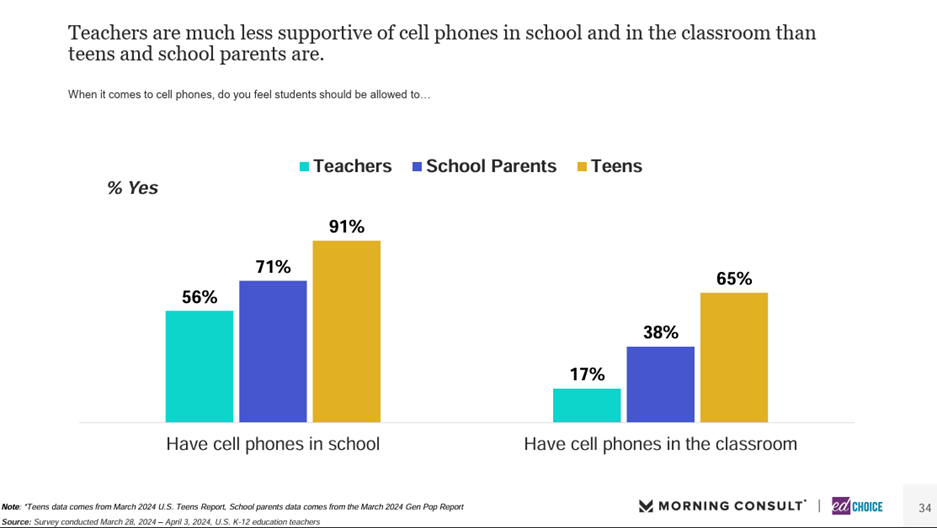
These findings stuck out to me because we’ve asked similar questions in our Public Opinion Tracker with Morning Consult. Around the spring of 2024, we asked school parents, teachers, and teenagers whether or not students should be allowed to have cellphones in class and in school generally.
Unsurprisingly, teens and teachers are on opposite ends of this debate, with nearly two-thirds of teens feeling that students should have access to their cellphone in the classroom compared to only 17% of teachers who feel similarly. School parents find themselves solidly in the middle between teenagers and teachers on this question. This aligns with the sentiment shared by parents and children in the Gallup poll. That said, the fact that nearly 40% of parents feel their child should be allowed to access their cellphone in the classroom serves as a reminder that opinions on cellphone bans aren’t solidly predictable.
Our data differs a bit from the Gallup data in the study when looking at public opinion on the impact of cellphones. More than half of teens feel that their cellphone has had a positive (somewhat positive + very positive) impact on relationships with classmates (76%), academic performance (64%), and mental health (57%). Parents are more aligned with teens on this question than one might expect. More than half of parents feel positive about the impact of cellphones on their child’s relationships with classmates (69%), mental health (56%), and academic performance (54%).

It’s important to point out that the Gallup poll asked parents and their children about how a potential cellphone ban would impact things like relationships, test scores, and mental health. Our data asks about the other side of that coin, asking how impactful cellphones are, rather than the impact of removing such technology. It is an imperfect comparison, but one that suggests parental support for cellphones bans might be more conditional than headlines might imply. One-third of parents want their kids to have access to cellphones in the classroom, and most see cellphones as a net positive for different areas of their child’s life. That complicates any claim of a unified constituency behind cellphone bans.
Moving Forward
The cellphone ban debate is satisfying precisely because it feels solvable. Pouch the phones, reclaim the classroom, move on. However, the moment we widen the lens to school issued laptops or potential use of AI tools, the tidy solution of banning cellphones starts to look like one move in a much longer game.
A longer game that, undoubtedly, requires the promise of school choice options for all families to access. As schools work towards effective solutions on the questions of cellphones and technology generally, parents should have the ability to choose the educational environment that implements rules on cellphones and technology that align with their views and their child’s needs.
None of this is an argument against trying, far from it. But I am wary of treating these cellphones ban experiments as the last word on cellphones, or tech generally, in the classroom. If we want to get the relationship between kids and technology right, we’ll need the patience to keep asking the hard questions long after the pouches are zipped.
This was originally published to our Substack.
Latest from the Blog
-

ESAs Are Full of Guardrails: A State by State Guide
Guardrails are requirements in state law or regulation that a parent must adhere to in order to receive an ESA on behalf of their child; we dive into all 21 ESA programs across the country.
-

End of School Year Survey: Parents Divided on Technology and Student Preparation for Life after Graduation
We asked thousands of Americans and school parents to share their perspective on a variety of topics ranging from tech in the classroom to preparing students for life after high school.
-

Surveying LGBTQ Americans and School Parents
June is Pride Month, an important time for those of us in the field of education to listen to the perspectives of LGBTQ students and school parents.