
Gifted, Talented, and Switching Schools
We’ve surveyed parents about advanced/gifted education off and on since 2023, using our Public Opinion Tracker. In that time, we’ve learned a couple of things.
First, school parents highly value having advanced education opportunities at their child’s school. This finding has stayed extremely consistent over the years. In June 2026, two-thirds of parents (67%) said it was extremely or very important that their child’s school offers advanced academic classes. Eighty-two percent of parents of gifted children said having advanced classes is extremely or very important.
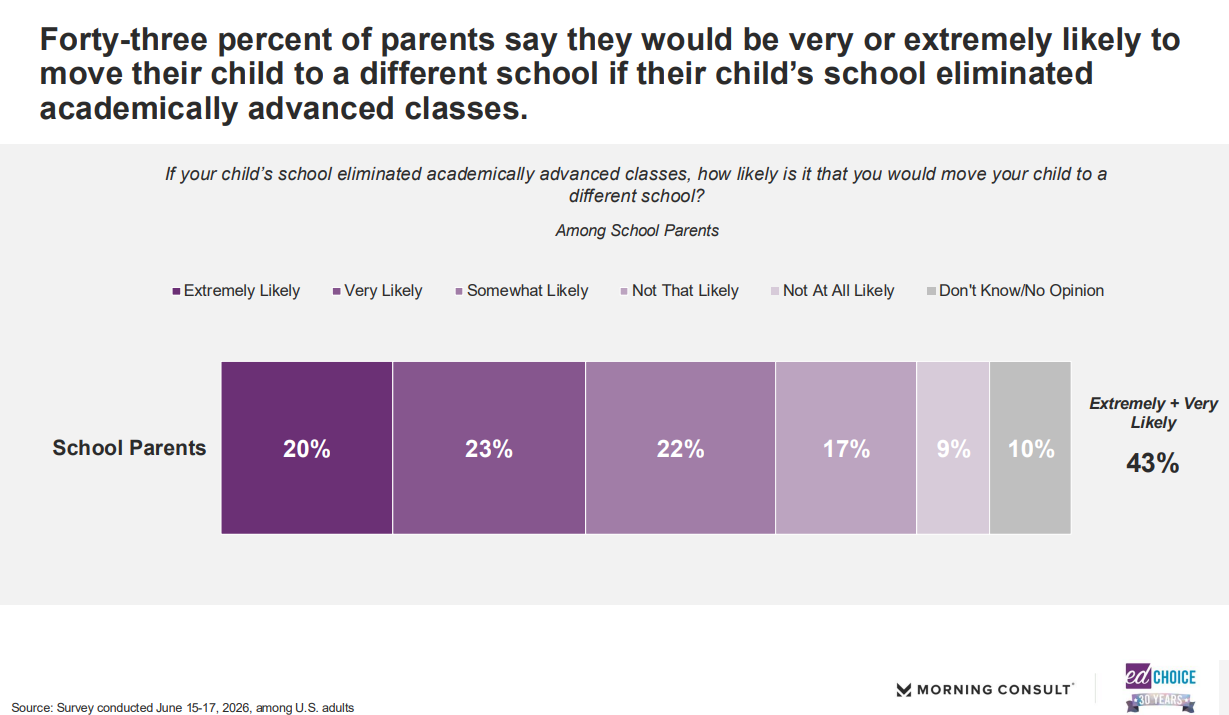
Second, parents take having advanced ed options seriously—to the point that many parents say they might switch schools if their child’s current school eliminated academically advanced classes. Forty-three percent of parents said they’d be very extremely or very likely to change schools if their current schools got rid of advanced classes. That rises to 57% among parents of gifted children, who have at least one child already participating in an advanced, honors, or gifted class at school.
These findings clearly indicate that advanced education is important to parents. But it also leads to an important follow up question: are parents with gifted children currently switching schools (AKA exercising a form of school choice) in order to access advanced education?
To investigate, we asked a new variation of our standard school switcher question in our most recent tracker survey, specifically targeted to parents of gifted children. Just over a quarter (26%) answered that their gifted child has switched school types at some point in their education. In comparison, we typically see that just under a quarter of all school parents report their child has switched school types (22% when we last asked in May).
There is a slight difference between the general population and parents of gifted students, but not enough to draw any firm conclusions. In other words, it’s hard to say for sure whether parents of gifted children are actually more likely to change schools in practice.
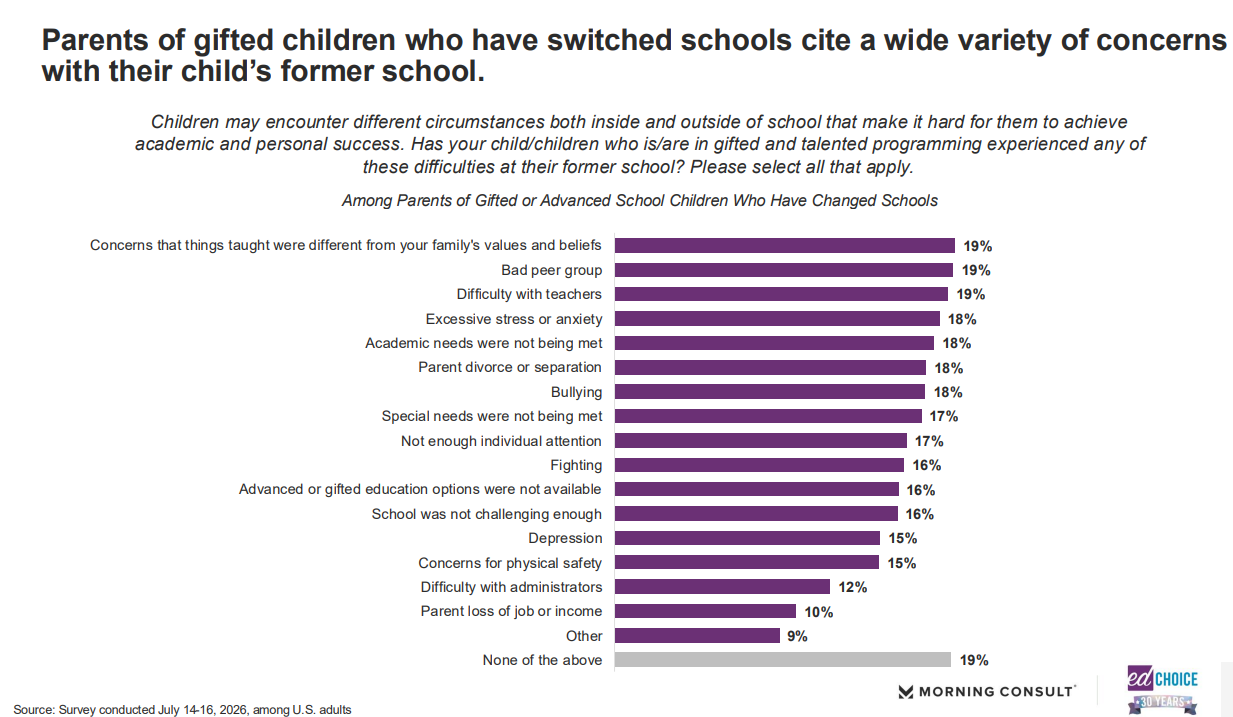
We also asked about the reasons behind school switching, by asking parents what difficulties students experienced at their former school. Posing this question to parents of gifted children yields interesting results. In short, there’s no clear frontrunner as the top reason why gifted kids change schools. That’s a sharp contrast with the results we generally see when we ask all parents, in which bullying stands out as the single top answer, followed by stress and anxiety.
Of course, public opinion polling always has limits. Truth be told, we might need a more empirical approach to get a clear answer. But that route also presents challenges. There’s no consistent way to identify kids as advanced learners—policies vary enormously across the country, and even within states. That makes it really tough to measure whether they are more likely to change schools, or whether they’re more likely to participate in school choice programs. We just don’t have the data.
So, while research can show that students with disabilities are overrepresented in private school choice programs, it’s difficult to replicate the analysis for gifted kids.
In the absence of a nationwide effort to consistently define and accommodate advanced learning needs, our central question of how many gifted kids use school choice remains inconclusive. But we can still consider ways to improve access to advanced education for however many families do need those options.
Naturally, I’ll go out on a limb and suggest that working to expand school choice access for all students will also, by extension, help advanced learners. Making a wider variety of educational options available will help students whose learning needs aren’t served by a one-size-fits-all model.
Automatic enrollment offers another potential way to improve access to advanced ed, even within the context of a traditional public school. Traditionally, students must “opt in” to an advanced class, whether by parent sign-up or teacher recommendation. That method can run the risk of leaving out some students who would benefit from advanced ed.
In an automatic enrollment model, all students who qualify are automatically placed in advanced classes—though, of course, parents can still choose to opt out and remove their child from those classes if they wish. This approach purposefully casts a wider net, hopefully accommodating a higher number of advanced learners and mitigating inequities in the selection process.
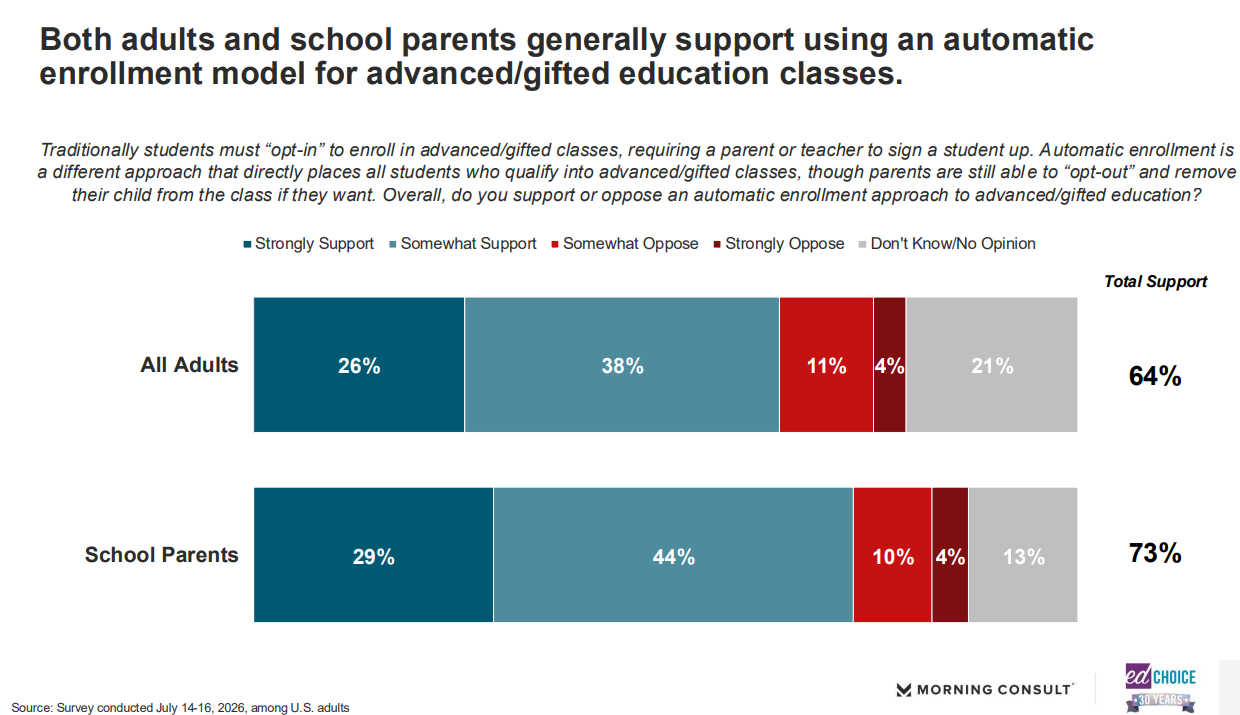
And, according to our survey results, automatic enrollment for advanced education is popular. Two-thirds of adults and 73% of school parents support using this approach.
To make a long story short, the quest to accurately measure the advanced education landscape continues. In the meantime, let’s focus on how to best help kids.
This was originally published to our Substack.
Latest from the Blog
-

This Is What Passing an Education Bill Feels Like
EdChoice Academy brings the challenges of passing state education legislation to life through an interactive simulation.
-

EdChoice Legal Advocates Wins Major Victory Defending Tennessee School Choice Program
EdChoice secured a major victory for Tennessee families Monday when a three-judge panel dismissed a lawsuit challenging the state's ESA.
-

Teachers Support Federal Tax Credit, Prioritizing Education Issues As Midterms Approach
A new survey explores teachers' views on the Federal Tax Credit for Scholarships, education priorities ahead of the midterms, and more.