
Is Arizona’s ESA Plagued by Unallowable Expenses?
Correction [July 23, 2026]
EdChoice has revised the original Arizona ESA research brief – published on April 1, 2026, and used for this post – after identifying tabulation errors regarding ESA reimbursement transactions. This correction changes several descriptive totals, averages, relative proportions, tables, figures, and associated statements.
The revised analysis continues to estimate the overall rate of unallowable ESA spending at approximately 2 percent. The correction does not change the original brief’s core findings, overall interpretation, or policy recommendations. The analyses – focused on Marketplace transactions – have not changed.
This post has been updated to align with the revised research brief published July 23, 2026. We apologize for the error. For questions, please email EdChoice’s research team.
After Arizona opened its Empowerment Scholarship Account (ESA) program to all families in 2022, a program that took a decade to enroll 10,000 students ballooned to ten times that number in just three years. The 100,000 families spending ESA funds in 2025-26 have over 2 million transactions worth over $1 billion for education goods and services. Stakeholders are catching up to the scope of this program and beginning to ask important questions about whether those dollars are in fact going to educational expenses. Our new report digs into the transaction-level data to find out. Our results demand more nuance than many recent headlines want you to have.
Why this matters
Determining how these funds are being spent is a monumental task, and the sheer volume of transactions has led different sources to take different methods managing the data toward answers. We took a two-track approach, aiming to provide as rigorous and relevant a study as possible.
The first is an examination of a statistically representative random sample of all transactions done on the ESA Marketplace platform. Our random sample size of 2,700 Marketplace transactions offers a 99% confidence level with a 0.5% margin of error. We also reviewed every transaction ourselves, as opposed to dividing and conquering, to ensure we minimized internal inconsistencies in judging what met or didn’t meet program guidelines. This random sample also offers a more representative look than a risk-based approach, which is better at quickly identifying transgressions and how bad they are than depicting the overall state of a program.
The second track is a line-by-line look at the 16,500 most expensive items (costing $500 or more) purchased on the same platform. We included this approach to offer a clearer vision of the relationship between unallowable expenses and taxpayer dollars lost to them. Public concern focuses on the expensive purchases, not a roll of paper towels.
Marketplace was chosen for analysis for two reasons. First, its data, which we received directly from ADE, was the most descriptive compared to other channels and allowed for more thorough categorization and comparison. Second, existing evidence suggested it is the main mechanism in which parents may be able to purchase items that are unallowable according to the ESA Parent Handbook.
Our findings suggest that the purchase of unallowable items on the Marketplace represents a small fraction (1-2%) of all ESA spending. Even so, we find there are opportunities for improvement to aid both administrators and parents with compliant spending without impacting family flexibility, which can bring that unallowable spending rate closer to zero.
Here’s how we got there.
How the money moves
To understand misspending in the ESA program, you first need to understand how Arizona’s ESA dollars actually get spent. Families have three main options: direct pay (sending money straight to a pre-approved vendor like a private school), reimbursement (buying something with personal funds and submitting a receipt to be paid back), and Marketplace (shopping through an e-commerce platform managed by ClassWallet, which includes over 100 state-approved stores).
89% of ESA dollars flow through direct pay and reimbursement. Marketplace, by contrast, accounts for only 12% of total spending. Yet, it constitutes 58% of all transactions, because the average purchase there runs just $59.

Most of the questionable purchases reported in local media appear to occur through Marketplace. Evidence from the Arizona Department of Education’s (ADE) own audit shows effectively zero unallowable spending in the direct pay channel and a relatively low rate in reimbursements. Marketplace accounts for about three out of every four purchases ADE flags for risk-based auditing. So even though little money flows through Marketplace relative to direct pay and reimbursements, it has received the most scrutiny.
What the data show
We pulled a random sample of 2,700 Marketplace transactions from the 2024-25 school year and reviewed them line by line against ADE’s guidelines. (We could not review reimbursements because the data we received from ADE did not contain any item names or descriptions.)
About 12% of those transactions were unallowable. Scaled up to all Marketplace spending, that works out to roughly $10.7 million in unallowable purchases, or about 1.5% of total ESA spending.
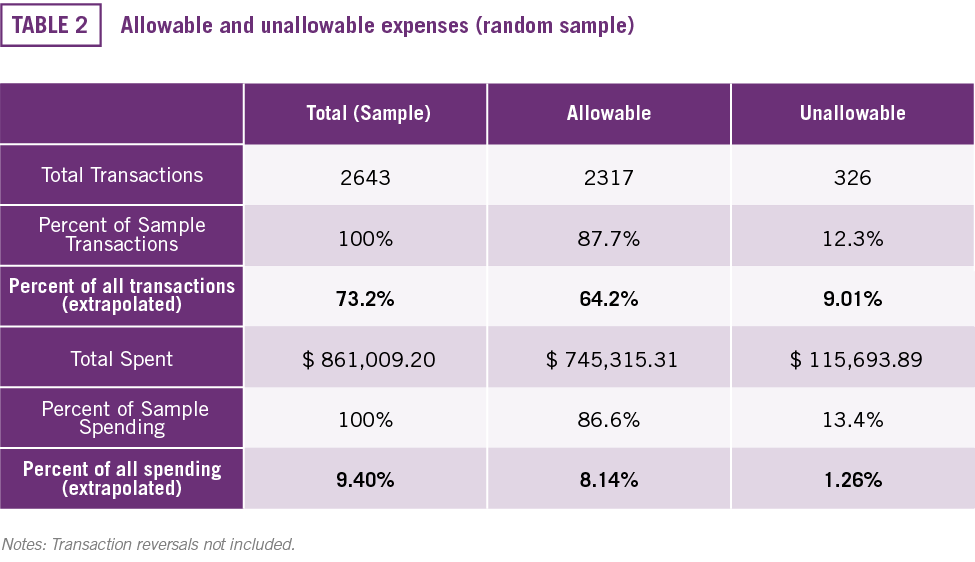
It’s worth noting that many of these calls are genuinely judgment-dependent due to the sometimes unclear and self-contradictory ADE guidelines. A weighted blanket might be bedding (prohibited) or it might be a sensory tool for a student with autism (allowable). Without personal information about the student the transaction was for, it is impossible to know for sure whether this transaction should be okayed. Audio/visual players are allowed, but audio/visual equipment is not. Without official definitions, we have to make them ourselves. We used our best judgment based on ADE’s general premise of “primarily educational expenses,” but we still found 430 transactions where judgments are necessarily subjective in nature.
Despite the subjective nature behind many of these evaluations, our results align rather closely with other studies using different approaches.
For the most common unallowable items, the list is mostly mundane: clothing, backpacks, and cleaning supplies. These are cases where families appear to be making honest mistakes based on assumptions about what ADE considers an allowable education expense. Genuinely egregious purchases were rare, though costlier on average.
An important question, then, is just how many of the expensive items were noneducational?
Because Amazon dominates Marketplace, with over 80% of all Marketplace transactions running through it, we also took a close look at Amazon’s 1.1 million transactions specifically, zeroing in on the 16,580 purchases of items that cost $500 or more.
After a line-by-line review, about 10% of those expensive purchases, roughly $1.3 million worth, appear to be unallowable, or 0.3% of total ESA spending. (To be clear – these unallowable purchases are within the aforementioned $10.7 million in Marketplace unallowable expenses.)

The enforcement tradeoff
Determining how many unallowable transactions are expensive or egregious is not mere exercise. It bears significant consequences for what responsible administration and policymaking looks like.
The vast majority of unallowable transactions are tiny. More than half of Amazon purchases cost under $20. Chasing down every backpack and bottle of hand sanitizer would require ADE to dramatically expand its review capacity to recover amounts that often don’t justify the expense to taxpayers.
In Q2 2026, ADE had to process more than 12,000 ESA purchases every day. If the goal is to eliminate the unallowable expense rate, taxpayers will have to pay more staff to review thousands of purchases that ultimately are trivial to Arizona’s education budget. Instead, the goal should actually be reducing taxpayer dollars lost to noneducational expenses, both from users and administration.
The more responsible path forward, then, is systemic and technological. First, clear up program guidelines to make compliance easier, both for families and administrators. Second, limit access to approved stores to the Marketplace portal rather than using ClassWallet credentials directly on store websites. Third, find a way to utilize ever-improving technology to limit the ability to buy the most clearly non-educational products on Amazon (think gaming consoles and graphics cards, not computers), as several ESA states have done already. Those kinds of changes could meaningfully reduce high-dollar misspending without the overhead of expanded human review, and without making the program harder to use for families who are doing things right.
Measured research for a measured response
Unallowable spending in Arizona’s ESA program is real, but it’s concentrated in a specific channel (Marketplace), mostly involves low-cost items, and amounts to somewhere between 1-2% of total program spending. As a share of Arizona’s overall K-12 expenditures, it’s less than a tenth of a percent. That’s not a reason to ignore it, but it does demand the state respond with administrative chisels and not legislative sledgehammers.
Update: Read our rebuttal to 12News.
Latest from the Blog
-

EdChoice Legal Advocates Wins Major Victory Defending Tennessee School Choice Program
EdChoice secured a major victory for Tennessee families Monday when a three-judge panel dismissed a lawsuit challenging the state's ESA.
-

Teachers Support Federal Tax Credit, Prioritizing Education Issues As Midterms Approach
A new survey explores teachers' views on the Federal Tax Credit for Scholarships, education priorities ahead of the midterms, and more.
-

Appeals Court Rules Against Ohio EdChoice Program, Parents Will Appeal to Ohio Supreme Court
Families will appeal today's ruling by the Ohio Court of Appeals that the state’s Educational Choice Scholarship program is unconstitutional.