
New Survey: Back to School and Election Season
Fall is officially here, marking the start of a new school year. Midterm elections are on the horizon. In this time of change, public opinion polling offers fresh insights into how the public and parents feel about top K-12 education issues, as well as their priorities going into both election season and the 2026-2027 school year.
In partnership with Morning Consult, EdChoice surveyed a nationally representative sample of approximately 2,250 adults and 1,300 school parents each month in June, July, and August. Read the full polling report here. Here are the highlights:
Midterm elections aren’t far off, and Americans have clear voting priorities.
We asked Americans about the top three issues on their mind when voting. By far, adults are most concerned with the economy. Economic issues ranked as the clear first priority when casting a vote for both federal (69%) and state (67%) offices. Health care issues came in second, and education ranked third.

People generally like political candidates supporting ESAs.
On the topic of education issues, we took a closer look at how Americans would perceive a political candidate who supports education savings accounts (ESAs). About one third of American adults (32%) said they would be more likely to vote for a candidate who supports ESAs, while 36% said it would make no difference. Only 6% said they would be less likely to vote for a candidate who supports ESAs. Parents feel even more positive. Over half of school parents (52%) say they’d be more likely to vote for a candidate who supports ESAs, compared to 28% who are ambivalent and 4% who would be less likely to vote for them.

ESAs are well-liked in general.
That finding about political candidates is not surprising considering that public opinion about ESAs is very positive overall. In August, over three-fourths of school parents (78%) and over two-thirds (67%) of all adults supported ESAs. We use this question to track how support for ESAs changes over time, and the results show consistently high support for the policy.

The new Federal Tax Credit for Education is also popular—though not very well known.
The Federal Tax Credit for Education is set to launch in January 2027, so we’re still in the early days of gathering public opinion. But as of now, support is high. Seventy-seven percent of school parents and 64% of adults support their state participating in the new tax credit. That said, there is more work to be done on improving awareness. Only 27% of parents and 16% of adults say they’ve heard a lot about it.


It’s also the start of a new school year, and time to check in on how the country feels about the direction of K-12 education.
With the 2026-27 school year just kicking off, the majority of Americans remain pessimistic about the direction of K-12 education at the local, state, and national level. Only 27% feel positive about education nationwide, rising to 39% when it comes to local education. School parents tend to be more positive (by about 10 to 20 points). Over half of parents (57%) say education is going well in their local school district, though only 41% feel good about education in America.

This school year, parents are most focused on their child’s academic progress and mental health.
We asked parents to identify what is taking up most of their attention going into the 2026-27 school year. Parents are most focused on their child’s academic progress (37%), mental health and wellbeing (33%), and school safety (30%). Their single top priority is most likely to be academic progress or mental health. Academic progress seems like a natural top priority when entering a new school year. It’s striking that mental health is garnering so much attention from parents right now—something for schools and families to be aware of.

Now, for something completely different—people support an automatic enrollment approach to advanced/gifted education classes.
Our full polling report dives deeper into a wide variety of issues in K-12 education. For example, we feature a section on advanced and gifted education. For the first time, we asked respondents whether they would support an automatic enrollment approach to advanced and gifted classes—a system in which all qualified kids are automatically placed into advanced classes, instead of needing to “opt-in” by being signed up. School parents like the idea of automatic enrollment by a large margin, with 73% expressing support. About two-thirds of adults (64%) support it.

Latest from the Blog
-
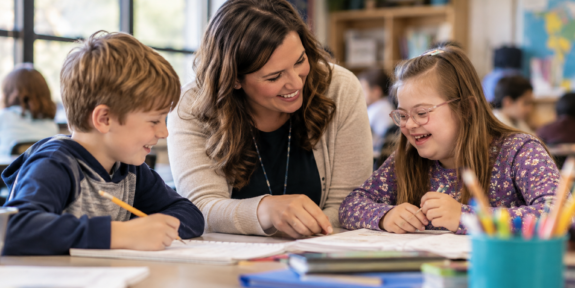
Students with Disabilities More Represented in School Choice
New research co-authored by EdChoice researchers finds that students with disabilities participate in private school choice programs at higher rates than in public schools, challenging common assumptions about educational choice.
-

The Impossible Standard for ESAs: Zero Misuse
EdChoice’s Marty Lueken explains why ESA programs need strong oversight without sacrificing families’ access to educational opportunities.
-

New Report: Educational Freedom Grew and Test Scores Improved
Arkansas’s educational choice program got bigger, and the average test performance of the students got better.