
The State of the American Summer Camp
ESAs can help more children participate in a rite of passage
As Alice Cooper sang, “school’s out for summer,” which means parents need to figure out how to keep their kids occupied.
Camp is a popular option, and it is a rite of passage for many American youths. There are lots to choose from, catering to all manner of different tastes. Whether you fancy the performing arts, basketball, E-Sports, or even digging holes, there’s probably something out there for you to try.
Some camps are costly, though, especially for low-income families. Although there are both federal government and private charity efforts to provide summer camp experiences at reduced prices, parents find that they need to be strategic in how they pay for them.
A recent report by the After School Alliance sheds more light on the state of the American summer camp. Let’s dive into the most illuminating findings of the report.
First, regarding this study’s methodology—there is a huge sample size: 30,515 households were surveyed, and the authors chose 11,561 of them for follow-up questions. Then they weighted response rates by demographics and geographic region to produce final results that carry just a +/- 1% margin of error. We note that this accounts for the fact that there wouldn’t be the same kinds of outdoor activities easily available to a family living in New York City as there are for one living in the suburbs of Salt Lake City, for example.
On to the results. The researchers found that high-income families are more likely than mid- or low-income families to both enroll their children in multiple camps during a single summer, and to enroll them in a “specialty” camp (described as, “arts, sports, drama, religious, STEM, etc.”). The differences aren’t huge (24% of high-income families have kids in 3+ camps versus 14% of low-income, 26% high-income have kids in specialty camps versus 6% of low-income) but worth noting all the same.
As the survey shows, families with means use these months to keep their kids engaged with summer enrichment programs, while lower-income families face the same financial barriers that too often define the educational options available to them.
This is a place where Education Savings Accounts, particularly those that offer a wide variety of spending options, can close the opportunity gap. In Arizona, for instance, parents can use ESA funds for approved summer education programs, flipping the dreaded summer learning loss into a season of academic gains for families traditionally left behind.
As you can see on page 36 of this report, the average weekly cost of specialty camps and programs in 2024 was about $328. Those costs multiply for multi-week programs, as well as for families who wish to send at least two or three of their children to a specialty camp.
Let’s look at an example. A K-4th grade student enrolled at White Tanks Christian School in Surprise, Arizona pays tuition up to $7,500 per school year. The most recent average Arizona ESA account value (for 2024-25) is $9,572. If a student has around $2,000 per year left over to spend on non-tuition approved expenses, he or she could take part in Camp Invention (for a weekly price of $275) or the Camp Pathfinders (for $375), or both!
Unfortunately, by our best estimates, only ten of the country’s ESA programs currently cover summer camps as permissible expenses. If that number rises, a lot more children will be able to benefit from fun and character-building summer experiences without their family needing to sweat the costs.
The demand for summer camp is well documented, but what factors into a parent’s decision to send their children to a particular camp? The survey authors had respondents rate no fewer than ten features of a camp experience and measured which ones were most frequently rated “very important.” “Safety of environment” won at 80%, while having knowledgeable and caring staff was the second most popular choice at 73%. The survey asked the same question for a hypothetical afterschool program, and those two characteristics were likewise the top two vote-getters (at 76% and 70%, respectively).
One of us (Cooper) has firsthand experience helping run summer camps in Baltimore, Maryland. This particular summer camp’s curriculum was designed to provide students living in a dangerous neighborhood with a safe environment that encouraged them to cultivate new hobbies and become stronger students. It also allowed these students to work together in teams, teaching them life skills such as collaboration and communication. For most students who attend, it is the first time in their young lives that they experience any structured summer learning environment, primarily because other options were unavailable or too expensive for their families.
Summer camp also provides formative experience for counselors who were put in leadership positions, encouraging them to be responsible caretakers and good examples for their campers. Americans who are camp counselors across the country have similar experiences, as for many, it is their first job. Indeed, lots of teenagers and adults put in time and effort every summer to make camp experiences as rewarding and fun as they can be for the attendees.
This survey found that an impressive 96% of respondents who had a child attend summer camp in 2024 reported that they were satisfied with it (and 63% said ‘very satisfied’). That’s an almost unbelievably uniform consensus. Do 96% of people agree that the sky is blue?! Who’s to say, these days.
With the aid of the Afterschool Alliance survey, hopefully we have painted a picture of what opportunities there are for kids to go to a summer camp. Now, go jump in the lake.
This was originally published to our Substack.
Latest from the Blog
-

Summer Reading: Reducing Chronic Absenteeism
As we start to think about next school year, taming chronic absenteeism needs to be a serious priority.
-
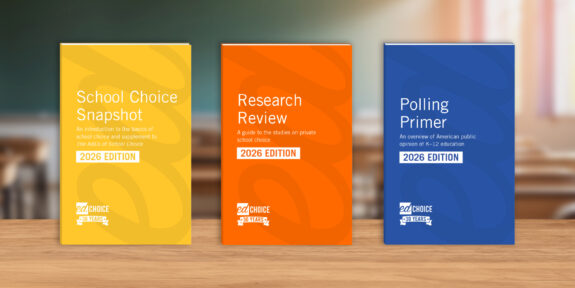
The 2026 EdChoice Bundle is Here!
The Bundle Basics, the first three of our six annual Bundle products, are out today and critical reading for those seeking to understand the current status of the school choice landscape.
-

Audit ESAs Like We Mean to Keep Them
When reviewing an audit report, we recommend doing three things. First, ask if the purchase is something that other schools already buy. Second, keep an open mind. And third, avoid overreaction.