
“This Is Just a Federal Tax Credit:” Leslie Hiner Breaks Down the FTCS at SPN
In August, EdChoice provided a special update, and networking opportunity, for our partners on the Federal Tax Credit for Scholarships (FTCS) at State Policy Network’s Annual Meeting 2026 in Orlando.
The private breakfast hosted in EdChoice’s Marriott suite featured remarks by Leslie Hiner, EdChoice’s Senior Advisor for Legal Policy, who has been a warrior in the school choice movement for 40 years and recently has become an expert on the Federal Tax Credit for Scholarships.
Attendees represented groups in at least 10 states, including Kansas, California, Virginia, West Virginia, Alaska, Montana, Pennsylvania, Florida, Massachusetts, and Illinois, as well as several other groups.
Just A Federal Tax Credit
Leslie reassured the group that conversations on the FTCS get easier when people remember that it is simply a tax credit.
“This is just a federal tax credit,” Leslie said. “It’s not a federal education program. It’s just a tax credit. Keep that in mind at all times.”
The U.S. Dept of Treasury (Treasury) is on track to deliver rules for the FTCS by the end of September, Leslie said, but the September rules will not cover everything, she cautioned.
“Don’t be surprised if some of your questions are still unanswered,” Leslie said, adding that questions about expenditures will likely remain. “They’re going to do what they can now, and then next year there will be another round of rules that will come out.”
Final rules are expected by the end of 2027.
Treasury has also signaled it might want to let the FTCS get started on January 1, 2027 and see how people use it, Leslie said.
“I think that’s ambitious on their part but they’re new to this, so they’re learning along the way,” she said. Leslie noted that Treasury’s willingness to accept input from those who will be impacted by the FTCS is refreshing, if unusual for a federal agency.
“As you are talking to people in your states, I encourage you to tell people to chill a little bit,” Leslie said. “This is definitely one of those things that’s a work in progress. Get your SGOs ready to go, ready to launch with what we know you can do right now but also understand that this will grow. There will be a phase two to all of this. And it’s not a bad thing. That’s a good thing.”
“I’ve found that the more I use that language, this is just a federal tax credit, that people who are kind of edgy about this relax,” she said. Success will be measured over time, not all at once in January 2027.
The Public Schools That Want In
Leslie noted that some public schools — not just choice students — are also interested in participating in the federal tax credit.
“Many public schools and those advocating on their behalf see the FTCS as just a funding stream to the school,” Leslie said. “In their mind, the way they could make this work is not anything that we would ever consider to be funding that would go directly to kids, but that’s how many see it.”
She explained that some public schools are considering setting up a Scholarship Granting Organization (SGO) for all the public schools in their state. Each school would tell the SGO how many students they have and how much money they need per child. The school would provide a list of names to the SGO, which in turn would send money directly to the school, allocating funding pre-determined by the public school to each name.
“For those of us who have been arguing for school choice for a really, really long time, I ask: what do our opponents always say?” Leslie asked. “‘Crazy voucher people. All they do is use parents as a conduit to get money to private schools. It’s just funding for private schoolsfrom those evil legislators. That’s all that they want to do.’”
“I think I could probably recite all of their arguments in my sleep at this point!” she said.
“But here’s the deal. I think they really believe this, because this idea is what we’re hearing from public schools, except now the beneficiaries are public schools, in their minds. There are public schools that are stepping up to participate, which is mostly a positive thing, except they have this view of what we do that’s false, that’s been drilled in by the teachers’ unions for decades now, and they’re applying that viewpoint to this new federal tax credit.”
“This is where we’re getting a little friction in states,” Leslie said.
“I’ve been fighting these battles now for 40 years, and yeah there have been some rough battles, but getting past those battles has always been about reaching out and coming to consensus together,” she said. “I don’t think we should assume that everybody understands this, and that oh yeah, public schools, they get this, no problem. Well, they’re new. They are completely new to participating in school choice systems, which is funding to students, not schools.” School choice advocates have been telling the truth all along, that parents are not mere conduits; empowering parents, on behalf of their children, to choose education has always been the primary focus of every school choice measure.
“What is the bottom line? Parents should have the freedom to choose whatever their kids need for education. School choice has never been about directing funding to a particular type of education, school, or education provider. Parents choose. And parents should be free to access the school or education provider or method of their choice ,” Leslie said.
“Who cares where or how kids are being educated. Are they being educated? Are they learning? We care about that,” she said.
What Can Students Purchase with FTCS Scholarship Money?
Treasury is still hashing out exactly how students can spend their scholarships, but we do know some concrete items already.
“If you stick with tuition, fees, services for kids with special needs, just what is written in black letter law, that’s a lot,” Leslie said. “You can do a lot with that.” Additional qualified expenses include academic tutoring, books, supplies, and other equipment incurredin connection with the enrollment or attendance at a public, private, or religious school.
“There are no limits for kids with special needs with this federal tax credit,” she added. “I think that this is just a huge bonus that people are often overlooking.”
Computer technology, equipment, internet access and related services used by the student and family while the student is in school are covered.
The law also states that qualified expenses include room and board, uniforms, transportation, and supplementary items and services (including extended day programs) which are required or provided by a public, private, or religious school in connection with such enrollment or attendance. Treasury has not yet offered guidance on what it means for these expenses to be “required or provided by” a school, and how that is different, or not, from expenses that are simply, “incurred” in connection with enrollment/attendance.
“There’s one thing I’ve found that helps people get their dreams and apprehensions under control,” Leslie said, “which is to say, read the statute. It’s really short! It’s extremely simple, straightforward.”
Treasury is “very intentional about getting this right,” Leslie said. “Maybe I’m a little jaundiced after all these years – I don’t normally expect that from the federal government! But in this case, Treasury is really trying very hard to get it right. So, if Treasury is trying hard to get this right, then I think we need to do the same thing.”
Homeschoolers
An attendee from the Virginia Institute of Public Policy asked how the FTCS would work with homeschoolers. Virginia has a large homeschool population.
“This is one of my pet peeves in all of this,” Leslie responded. “I think Treasury is getting something wrong. I’m doing everything I can to convince them that they’re wrong and we’re right.”
Treasury believes that a child who is eligible for a scholarship must attend a school in order to use that funding for qualified expenses. Treasury relies on the federal Coverdell statute, which lists qualified expenses applicable also to FTCS, and its definition of a school. Under Coverdell, a “school” is whatever a state defines to be a school.
“Well, so what’s a school anymore?” Leslie said, noting that the definition is in flux in many states, and some people who are educating kids do not even want to be called a school. Typically, homeschools and microschools – both fast-growing in popularity – prefer to not endanger their freedom to educate kids in innovative ways by being constrained by a “school” definition created for traditional bricks and mortar schools.
The HSLDA, a nonprofit that provides legal protection for homeschoolers, found that in the 10 states where a homeschool is defined as a school, homeschoolers may apply for FTCS scholarships right off the bat. In another 11 or 12 states, the language is less clear, but homeschoolers could take steps to be considered a school such as to file a document or agree to take the state test. However, Leslie believes that it was not the intent of Congress to place limits on homeschooled children who are otherwise eligible for the FTCS.
Leslie closed by encouraging people from different states to share their ideas.
“This new federal tax credit is difficult for people to embrace comfortably because we don’t yet have that clarity on rules that we crave so much. But if you’re talking to your neighbor in a neighboring state, you just might be able to find some kind of solution to potential obstacles, hear a good idea, or at least find a little solace in knowing that there’s a kindred spirit and you’re in this together, because we are in this together,” she said.
This communication between states is especially important for those in states that have never had a tax credit scholarship program. While state programs are different from this federal tax credit, those who have experience working with SGOs have valuable information and experience that is helpful to others.
If you missed Leslie’s private breakfast for partners on the FTCS in Orlando last month and would like more information, check out our dedicated FTCS page or reach out to Leslie Hiner directly!
Latest from the Blog
-
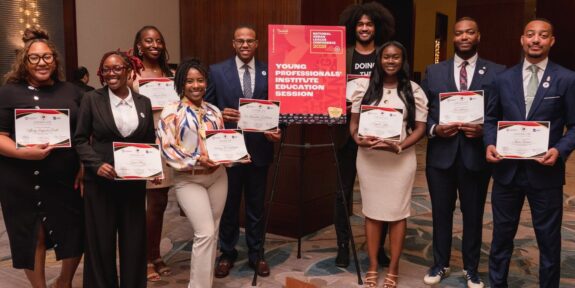
Developing the Next Generation of Education Advocates
We take a look at the Young Professionals Institute: Education Fellowship that is developing the next generation of education advocates.
-

Enrollment Down, Funding Up
We take a look at the myth that declining student enrollment is linked to declines in per pupil expenditures.
-

The Fiscal Case for School Choice and How to Craft Good Choice Law: EdChoice’s SPN Session
We recap our session at the 2026 State Policy Network's Annual Meeting in Orlando where we presented facts and arguments to combat both fiscal and legal attacks on school choice.