
What’s Next for the Texas EFA Program?
The participating population starts to take shape
For tens of thousands of families in Texas, school choice is becoming a reality. The application window for the Texas EFA program closed on April 1st, and funding will be sent to families later this month. For those interested in an overview of the program itself, I talked about it at length in a previous blog post.
This post will instead discuss what we know about the applicant pool, some of the myths around the program currently circulating in the media, and the future of the waitlist to enter the program.
What We Know About the Applicant Pool
For starters, just under 275,000 families applied to participate in the Texas EFA program, or roughly 5% of the total K-12 student population in Texas. The demand for the program surpassed the expectations of many and will put pressure on the legislature to allocate more funds to the program in the coming years, but more on that later. We know a good bit about the roughly 275,000 families that applied, including:
- 45% of the applicants are White, 23% Hispanic, 11% Black, 8% Asian/Pacific Islander
- 37% of applicants come from households earning less than 200% FPL (roughly $66,000). Another 36% come from households earning between 200% – 500% FPL (roughly $66,000 – $166,000).
- 77% of applicants plan to use the funds to enroll in a private school, while 23% plan to use the funds to homeschool.
- Largest applicant groups (eligible applications) by grade level are clustered in kindergarten or 1st grade, with roughly 50,000 total applications between the two grade levels.
These are just a few of the data points made available to the public. The fact sheet can be found here. Kudos to Texas and all those involved for making this data available so early on in the process. This type of data is really valuable to understanding the types of families showing interest in the program.
Discussion Around the Program
I’m hesitant to give air to some of the media discussing the EFA program, but here we are.
On April 1st, Houston Public Media published an article titled: “White Texans, students previously in private school or home-school make up bulk of voucher applicants.”
For those familiar with how choice programs have been received by the media over the last few years, this will feel a bit like Groundhog Day. The author starts playing the hits almost immediately. The author cites “undeniable data” that shows the majority of Texans oppose vouchers. The polling report cited can be found here. Peep the wording of the question: it violates even the most basic rules of survey question design by characterizing a voucher program as “a program that takes tax dollars away from local public schools to subsidize a student’s private school education.” Deniable, indeed. Texans are actually very supportive of both ESAs and vouchers, according to our own polling.
But that is neither here nor there. Choice is happening in Texas! Perhaps at this point, opponents will put down their swords and take an objective look at what’s unfolding with the program.
Haha, just kidding. Almost immediately, the author ignores the fact that the majority of applicants are nonwhite. Not a great start. Perhaps they’ll have learned from data on other programs about early adopters being mostly from privat…nope! Didn’t do that either. Okay…well maybe they’ll touch on the fact that the program prioritizes students with disabilities and low-income students. What’s that? The article ends on a note about how private schools are “generally not required to accommodate students with disabilities”, without any data showing this to be true? Sigh.
Perhaps I’m the fool for expecting an honest debate on what a school choice program should look like. Nearly 275,000 families applied! Notably absent is the question asking why these families are applying in the first place?
And, it is important to reiterate, these are just applicants. The EFA created priority tiers in the case that the program was oversubscribed. They are:
- Tier 1: Children with a disability who are members of a household whose total annual income is at or below 500% of the Federal Poverty Level.
- Tier 2: Children who are members of a household whose total annual income is at or below 200% of the Federal Poverty Level.
- Tier 3: Children who are members of a household whose total annual income is between 200% and 500% of the Federal Poverty Level.
- Tier 4: Children who are members of a household whose total annual income is at or above 500% of the Federal Poverty Level. Children who were enrolled in a Texas public school or charter school for at least 90% of the prior school year will be prioritized within this group. Funds for children in this category may not exceed 20 percent of the amount of money appropriated from the program fund for that school year.
The population that ultimately enrolls in the program will not be the same as the population that applied to participate.
As it stands, given the huge number of applicants, the state will probably have to conduct the enrollment lottery starting in Tier 2. That means that all students participating in the first year will either be students with a disability or from families earning less than 200% of the federal poverty line. Doesn’t exactly fit the narrative.
The Real Obstacle for Texas’ EFA Program
On April 3rd, Austin American Statesmen published an article titled: “More than 270,000 students applied to Texas’ school voucher program. Most will be turned away.”
Though it took a few days, mainstream media in Texas finally arrived at the chief problem within the Texas EFA program. Structurally, Texas’ EFA program is not built to fund the number of families it attracted. While I presume this is not news to many of our readers, we now know more about how this will play out.
This is hopefully a temporary problem. Demand far exceeded expectations, and now the ball is in the Texas legislature’s court. Upwards of 200,000 families signed up for the program but won’t get to reap the rewards. The stakes are quite high. This is not about private school students missing out on money to pay their tuition, despite how opponents characterize these programs. Leaving families on a waitlist means a student who is being bullied in their current school might spend another year feeling unsafe. Families counting on these funds to access tutoring outside of school can no longer do so. It is not hyperbole to say there could be thousands of families stuck in these bleak scenarios.
They are counting on the Texas legislature to help them out. The demand is clear. The only question remains if the legislature will step up to help meet it.
This was originally published to our Substack.
Latest from the Blog
-

Declining Enrollment Doesn’t Have to Mean Declining Schools
Declining enrollment presents real challenges. It also gives district leaders a chance to build stronger schools for the students they serve.
-

Everything People Care About More Than Standardized Test Scores
We asked parents to identify up to three out of a possible six indicators they look at to know if their child’s school year has been successful: standardized test scores were a clear least favorite.
-
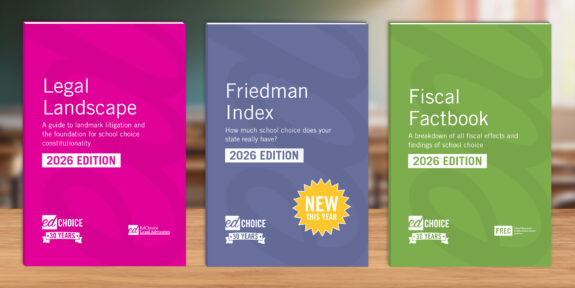
The 2026 EdChoice Bundle Pro: Friedman Index, Legal Landscape, Fiscal Factbook
New this year in the Bundle Pro, you will find our newest Bundle product, Friedman Index as well as a revamped Legal Landscape with more details about cases, and new sections in Fiscal Factbook on Arizona and the long-term effects of school choice.