
Special Education Treats Poor Kids Differently
Study finds low-income children are more likely to be diagnosed but less likely to receive help
One of the most frequently overlooked factors in policy implementation and evaluation is the human element.
Whatever laws governments create must be interpreted and enforced by people. And the biases people develop navigating the world often lead them to do so inconsistently.
A recent study by an Avengers-size assembly of education researchers, published in the Annenberg Institute’s working paper series, found some compelling evidence for one such inconsistency when it comes to special education.
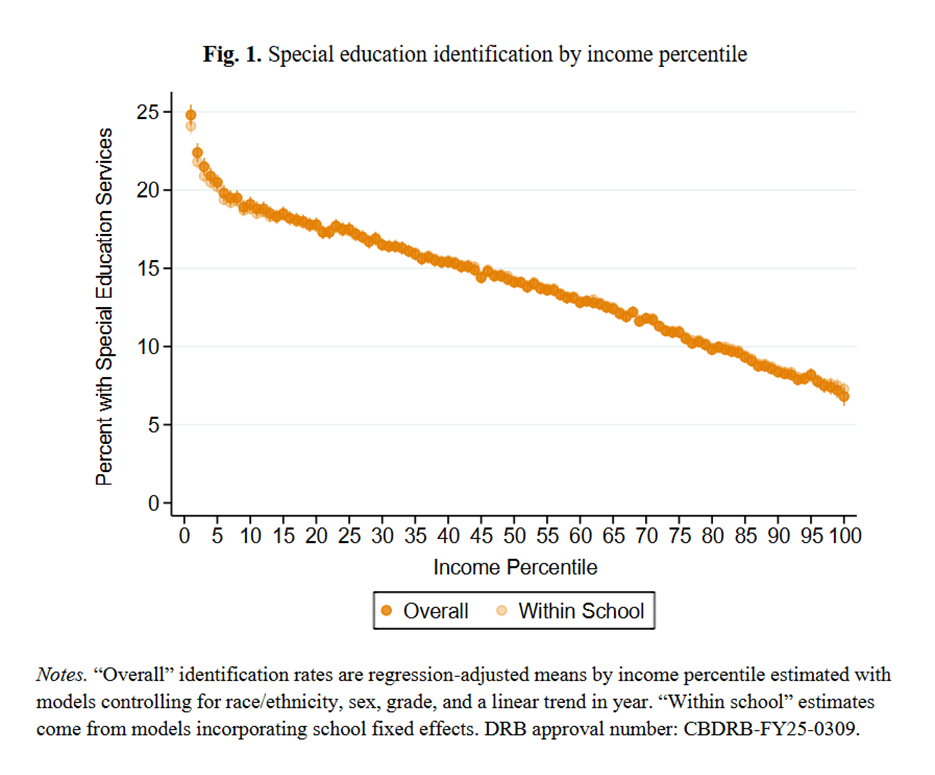
Looking at Oregon K-12 students from 2009 to 2019, the team found that children from low-income families were substantially more likely to receive a “special education” classification than children from high-income families. This isn’t simply a result of differences between the schools lower-income and higher-income kids attend. There is remarkable consistency in results when looking within schools and between schools. Whether a school has a lot or few low-income kids, those that are enrolled there are disproportionately likely to be identified for special education.
These findings clearly indicate that students from high- and low-income families receive very different supports even within the same school and suggest that either low-income students, high-income students, or both are not being classified on disability-related needs alone.
Source: Ainsworth et al (2026)
That’s not necessarily the surprising part. There have been decades of evidence pointing to a relationship between poverty and hampered child development, so we might expect lower-income children to have relatively more challenges that would translate to a disability classification in school.
It is what happens next that is the surprise.
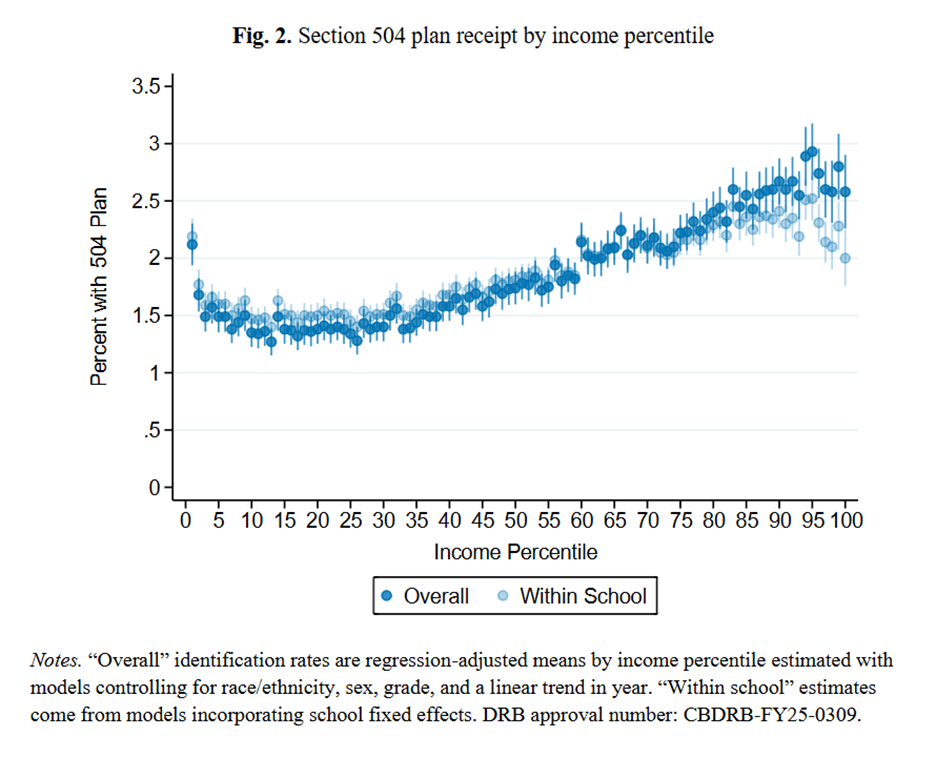
The research team found that, even though they were identified for special education at higher rates, low-income students were substantially less likely to receive a 504 plan compared to their high-income peers. Again, results were consistent within schools, so differences are not due to differences in the kinds of schools different kids attend.
Source: Ainsworth et al (2026)
At risk of oversimplifying for the sake of a blog (I welcome corrections from any special education specialists in the comments), the difference between a special education classification and a 504 plan mainly lies in the type of help they provide. Both were created to facilitate education for children who need specialized help to thrive academically. But special education offers specialized instruction (IEPs) from specialized staff, usually outside the standard classroom setting. 504 plans do not deliver “special education,” but rather grant access to accommodations within a general education classroom.
So, in other words, the researchers found that lower-income students were much more likely to be given the kind of help that takes them out of the regular classroom, while higher-income students were much more likely to receive accommodations to help them thrive in their mainstream class.
This gap can look more concerning when comparing results for specific diagnoses. The income gap is strongest for emotionally and socially stigmatized categories, namely “emotional behavior disability” and “specific learning disability.” Disabilities that the researchers term “higher status” disabilities due to their access to desirable special education services have notably smaller income gaps.
There are some similar gaps when comparing results for Black, Hispanic, and Asian/Pacific Islander students against White students.
Needless to say, the team concludes that disparities in actual student need cannot explain the massive differences in diagnoses and treatment they observed in Oregon schools.
But why do these gaps exist? The research team offers a couple complementary hypotheses that I see as very plausible.
First, adults evaluate a child’s differences and capabilities differently depending on what they know about a student’s background. Like it or not, sociological education research finds evidence of this occurring in school settings again and again. Because disability identification always involves some level of subjectivity, biases can take over. If we associate wealth with capability, what might be seen as a quirk in an affluent student may be categorized as a clinical emotional disturbance in a lower-income student.
Second, parents with influence may leverage available resources to help their children succeed. Parent advocacy is a key element of special education identification and programming. If a parent sees strategic benefit to certain accommodations particular to 504 plans, such as extra time to complete tests or assignments, they may leverage what they can to give their child the best chance to succeed. And, of course, there’s a relationship between income and influence.
Any legislation, however well intentioned, will be filtered through the human element. Policycraft must account for how individual preferences and heuristics will affect responses by those charged with implementing the policy, those the policy is intended to help, and the general public. This doesn’t mean that special education policy is inherently flawed or that there are obvious solutions. But it does mean simplistic conclusions assuming disadvantaged students get what they need from public schools because the law says they’re supposed to are probably misplaced.
These inconsistencies in identification and accommodation can help explain why so many students with disabilities use school choice programs. It seems inevitable that there will be students who are not given the proper diagnosis or help they need from their school. And while parents have routes to advocate for their child with a disability, they are often costly and also are subject to inconsistencies based on socioeconomic status.
Many families would switch schools if they could afford it. That’s partially why parents of special needs children are much more likely to switch schools, and it also probably helps explain why they support school choice policies at such high rates.
This was originally published to our Substack.
Latest from the Blog
-

This Is What Passing an Education Bill Feels Like
EdChoice Academy brings the challenges of passing state education legislation to life through an interactive simulation.
-

EdChoice Legal Advocates Wins Major Victory Defending Tennessee School Choice Program
EdChoice secured a major victory for Tennessee families Monday when a three-judge panel dismissed a lawsuit challenging the state's ESA.
-

Teachers Support Federal Tax Credit, Prioritizing Education Issues As Midterms Approach
A new survey explores teachers' views on the Federal Tax Credit for Scholarships, education priorities ahead of the midterms, and more.