
Understanding School Finance Means Appreciating Tradeoffs
My experience with the Edunomics Lab
It was the economist Thomas Sowell who argued, “There are no solutions, only tradeoffs.”
That was on my mind when, a couple of weeks ago, I attended a Certificate in Education Finance residency put on by the staff of the Edunomics Lab at Georgetown University’s McCourt School of Public Policy. Dr. Marguerite Roza presented most of the program’s content, focusing on spending decisions in public schools and school districts. I gained appreciation for the difficult tradeoffs that chief financial officers, superintendents, and school board members must consider when they weigh cuts to curriculum, programs, employee benefits, and jobs.
Because that is what education finance policy is all about: tradeoffs. Want to shrink class sizes? Well, you might end up paying teachers less because you need more of them. Want to get more technology in the classroom? You might not be able to hire reading specialists. And on and on and on. Schools and school districts do not have limitless amounts of money, so leaders often have to make tough choices between good things. They can’t do them all.
Dr. Roza led us through several simulations of school district fiscal dilemmas, mixing both real and fictionalized budget summaries and helping us interpret them. To give a concrete example, the room was equally divided on the merits of either hiring more salaried teachers or more part-time tutors to address a hypothetical district’s recent influx in English language learner students. We spent some time on an Edunomics data tool that plots a school’s English and math mastery rates against the average per-pupil expenditure. The data can reveal some important facts, like which schools have strong academic mastery rates despite modest per-student spending. Learning more about how these “value maximizer” schools make their funding decisions should play a bigger part in policy debates. In many states, charter schools are well-represented as value maximizers.
Before making a budget cut, we would learn a new piece of spending research, like the projected upcoming K–12 student population shortfall and the challenges in hiring math teachers. The economics of school labor costs covers a range of considerations, including pension obligations and adjustments to step-and-lane salary schedules. She explained to us the importance of categorizing new school or district expenses as either “recurring” or “non-recurring” especially in light of the ESSER money surge. Raising teacher or staff base pay is recurring, while awarding stipends and making modest facilities upgrades are non-recurring. There is a good argument that budget decision makers should opt for more non-recurring costs, because their future year budgets could be affected by things like regional migration patterns and local tax revenue.

We also talked about the federal government, the 800-pound gorilla of recent education spending. Although the federal government has funded parts of K–12 education since 1965, our focus was on trends that have been documented since the 2008 subprime mortgage crisis. The American Recovery and Reinvestment Act (the “stimulus bill”) awarded approximately $70.6 billion to the U.S. Department of Education, while the 116th Congress said “hold my dry-erase marker” and appropriated $190 billion (in three acts) to ED via the Elementary and Secondary School Emergency Relief Fund in 2020-21. Some researchers have noticed that districts added many staffing positions (which are recurring expenses) even though ESSER was meant to cover non-recurring expenses.
The Edunomics Certificate in Education Finance is a timely and useful program for anybody working in K-12 education policy. Knowing the essentials of where a district’s money is being spent and combining that with the knowledge of national and state fiscal trends is how districts can be smarter, savvier stewards of the public weal.
These discussions are also relevant when it comes to educational choice. At EdChoice, we know that school choice programs are a solution, for saving money and for boosting our kids’ achievement and ability to live fulfilling lives. When students leave a public school to use a voucher, ESA, or tax credit scholarship, only a portion of their funding follows them. The rest remains in their public school, even though they are no longer there. That means additional resources for the students who remain to pay for raises for teachers, technology, tutors, or anything else they might need. Seems like a tradeoff worth making!
Photos courtesy Edunomics Lab.
Latest from the Blog
-

Everything People Care About More Than Standardized Test Scores
We asked parents to identify up to three out of a possible six indicators they look at to know if their child’s school year has been successful: standardized test scores were a clear least favorite.
-
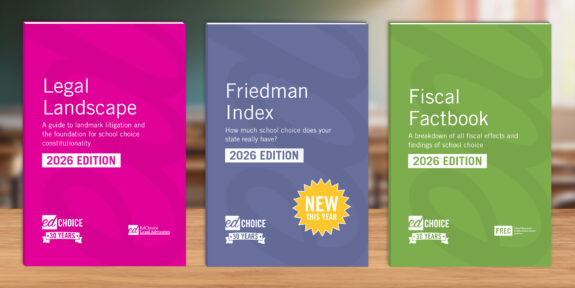
The 2026 EdChoice Bundle Pro: Friedman Index, Legal Landscape, Fiscal Factbook
New this year in the Bundle Pro, you will find our newest Bundle product, Friedman Index as well as a revamped Legal Landscape with more details about cases, and new sections in Fiscal Factbook on Arizona and the long-term effects of school choice.
-

Summer Reading: Reducing Chronic Absenteeism
As we start to think about next school year, taming chronic absenteeism needs to be a serious priority.