
NEW RESEARCH: The Fiscal Effects of School Choice: The Costs and Savings of Private School Choice Programs in America through FY 2022
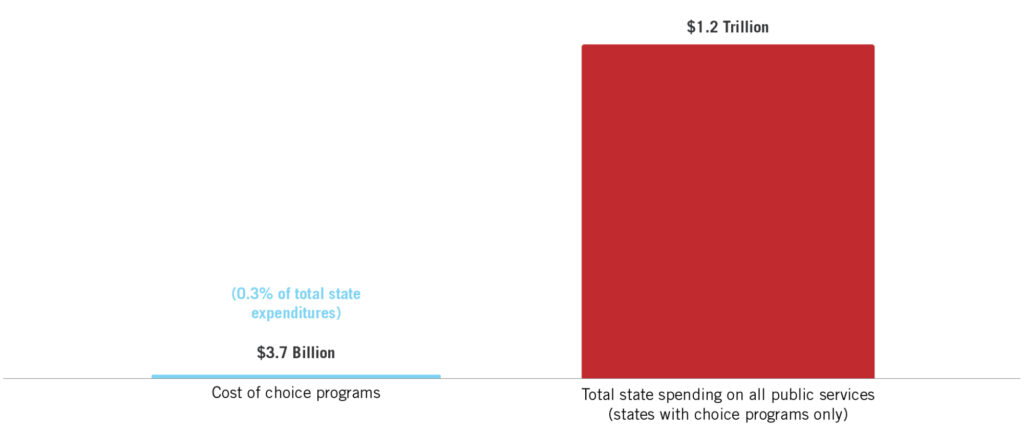
In recent years, critics levied a new argument against choice programs—that these programs are causing “budget meltdowns.” What does that look like? In FY 2022, private school choice programs accounted for 0.3% of total state expenditures on all public services in states where choice programs exist. That’s just a tiny fraction of the one trillion dollars in state expenditures on all public services.
Figure: Total Cost of Choice Programs and Total State Spending on All Public Services in States Operating Choice Programs
Fiscal analysis of a universal ESA program: Arizona
Recent reports have claimed that the ESA program in Arizona led to a “budget meltdown” in the state. Spending on the program in FY 2024 was $730 million, causing an outcry among critics. Once again, putting the program’s cost in the context of the state’s budget reveals that this amount represents just 0.9% of total state expenditures on all public services.
By the way, the ESA expansion coincided with a $2 billion budget surplus, but we’ll let readers decide for themselves if this construes a “budget meltdown” caused by choice. More on “the Arizona problem” can be found here and here.
Figure: Total Cost of Arizona ESA Program and Total State Spending on All Public Services in Arizona

But this claim looks at only one side of the fiscal coin. Critics fail to account for potential savings from students who are diverted from public schools, which is what any proper fiscal analysis should account for. The report offers some guidance for how government and other administration agencies can improve data collection about this group of students in order to provide policymakers with a more accurate understanding of universal choice programs and improve fiscal analyses of these programs.
Using data from the Arizona Department of Education to estimate switcher rates, the analysis estimates a net cost of $37million in the short run. What does that look like in the context of the state’s budget? It represents 0.2% of taxpayer support for K–12 public schools and only 0.05% of total state expenditures on all public services.
In the long run, the analysis projects that the current cohort of students in Arizona’s ESA program will yield net fiscal savings of $244 million annually. These results are a far cry from the decimation of the state’s budget levied by critics.
Policymakers should note that these fiscal effects ignore any indirect economic benefits that choice offers, such as lowering crime rates and improving longer term outcomes by reducing high school dropout rates and boosting post-secondary outcomes.
Given these findings, policymakers considering introducing or expanding choice programs can be assured that doing so will not financially harm public schools and will likely serve as a rising tide that lifts all boats, benefitting students in their state for generations to come. The evidence is clear: taxpayers benefit, school districts adapt well, and students—both in and out of choice programs—experience better outcomes.
Latest from the Blog
-
This Is What Passing an Education Bill Feels Like
EdChoice Academy brings the challenges of passing state education legislation to life through an interactive simulation.
-

EdChoice Legal Advocates Wins Major Victory Defending Tennessee School Choice Program
EdChoice secured a major victory for Tennessee families Monday when a three-judge panel dismissed a lawsuit challenging the state's ESA.
-

Teachers Support Federal Tax Credit, Prioritizing Education Issues As Midterms Approach
A new survey explores teachers' views on the Federal Tax Credit for Scholarships, education priorities ahead of the midterms, and more.