
Does School Choice Cause Public Schools to Close?
New study finds weak and inconsistent evidence that school choice increases public school closure risk
A group of parents in rural West Virginia filed a lawsuit last week with a familiar warning about school choice: as students and dollars leave public schools, some schools may eventually have to close. Their own school, Dingess Elementary in Mingo County, is now slated for closure. The parents argue that West Virginia’s rapidly expanding Hope Scholarship program is part of the problem.
It’s an intuitive argument. But is it actually what happens when states adopt private school choice programs?
The concern keeps resurfacing. Last year, a Washington Post article tied school closures to Arizona’s ESA program. John Kristof and I responded that enrollment in the featured Roosevelt Elementary School District had already fallen 27 percent before Arizona made ESAs universal, even as inflation-adjusted total revenue rose 20 percent and per-student revenue rose 66 percent.
Anecdotes can tell us what happened to a particular school. They are much less useful for telling us what caused it.
Looking nationally
That gap motivated my new study in the Journal of School Choice. Using school-level data, from 1992 through 2020, I estimated an event-study model that tracks public school closure probabilities before and after states adopt their first school choice program, with the year before adoption as the reference point and non-choice states as a comparison group. I also tested whether closure risk rises as private-choice market share grows.
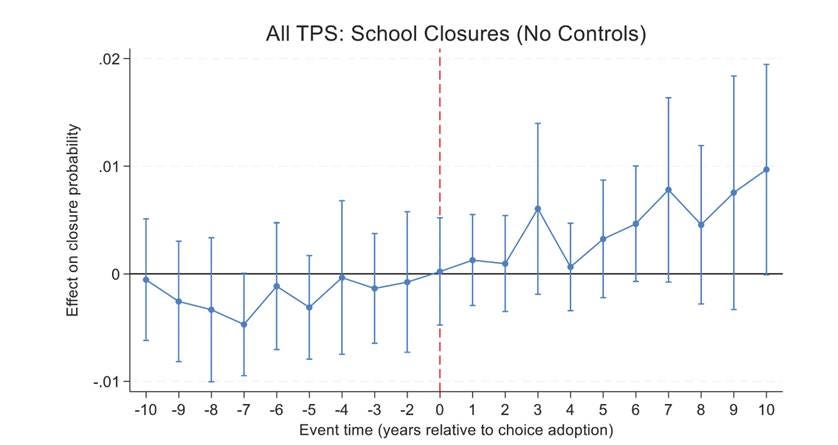
Public school closure probability before and after private school choice adoption.
The strongest result is what doesn’t happen: There is no abrupt increase in public school closures when a choice program begins. Estimates in the adoption year and first several years afterward are small and generally statistically indistinguishable from zero. Positive estimates sometimes emerge later, but they are mostly imprecise and inconsistent across models, and greater choice participation does not consistently translate into greater closure risk. Adding controls for public school enrollment, charter school market share, birth rates, unemployment, economic conditions and political factors generally makes the estimates smaller and less precise, reinforcing the overall story.
The rural results are especially relevant to West Virginia. I find no evidence of a post-adoption increase in closure risk among rural schools. The modest, delayed increases that appear in some specifications are concentrated mainly in urban and town schools.
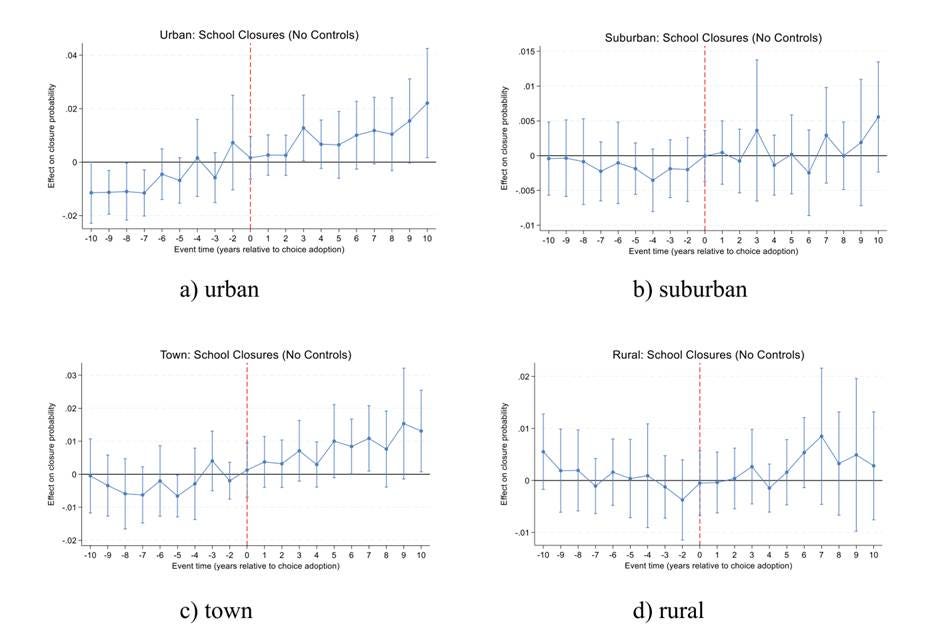
Public school closure effects after private school choice adoption, by locale.
This does not tell us whether the Hope Scholarship caused or contributed to Dingess Elementary’s proposed closure. My study looks for broad national patterns and ends in 2020, before the recent wave of universal choice programs. But the historical evidence provides little support for the broader claim that private choice systematically causes public schools, especially rural ones, to close.
A runway, not a cliff
There’s another important takeaway. To the extent a choice effect exists, it appears to materialize gradually rather than overnight.
That gives districts something valuable: time.
They should use it.
School closures can be disruptive, but prior research shows that outcomes depend greatly on how they are handled. A study of Ohio found that students displaced by closures made academic gains, particularly when they moved to higher-quality schools. Research in New Orleans similarly found that outcomes were more favorable when schools were phased out rather than closed abruptly and when disruption to students was minimized. Guidance for districts facing declining enrollment likewise emphasizes early planning and meaningful engagement with families and communities.
A school closure, in other words, is not inherently good or bad for students. Where students go next, and how thoughtfully the transition is managed, matters enormously.
Why might choice have such a weak effect?
For school choice to lead to a closure, several things have to happen first. Choice must cause enough students to leave a district school, those exits must reduce revenue enough to create sustained excess capacity, and the district must decide that closing a building is preferable to other adjustments.
School finance systems often weaken that chain. Not every dollar follows a student. Districts receive local property tax revenue, categorical aid and other funding not tightly tied to enrollment. States also use funding protections that cushion enrollment declines.
Recent research by Matthew Lee and Ben Scafidi reinforces this point. Using data from every U.S. public school district from 1998 to 2019, they find that districts experiencing declining enrollment generally had larger increases in per-pupil funding and resources than districts experiencing enrollment growth. Fewer students do not automatically mean fewer resources for each student who remains.
And choice is hardly the only force shrinking enrollment. A Bellwether analysis identifies falling birth rates as the primary driver of declining public-school enrollment nationally. Smaller cohorts are entering schools, while migration, housing patterns, charter schools, homeschooling and private schooling matter differently from place to place.
Blaming choice is too simple
School closures are consequential. Families care deeply about neighborhood schools, and policymakers should take seriously the disruption that closures can cause. School choice may contribute to enrollment changes in some places.
But blaming choice for public school closures is too simple.
First of all, choice comprises a small portion of publicly funded students—about 2.8% of K-12 students nationally participate in private choice programs. Participation in West Virginia’s Hope program represented 5.6% in 2026. Funding for Hope is just 1.6% of total funding for public schools in West Virginia.
In Mingo County public schools, enrollment was declining way before Hope enrolled students for the first time in school year 2022-23. Enrollment declined there by almost 20% between 2010 and 2023. Something else was happening before Hope even existed which contributed to the district’s declining enrollment. It’s rash to pin school closures on Hope given this context. Declining birth rates are likely one significant contributing factor, given that the birth rate declined by 14.3% between 2012 and 2024 in West Virginia. There may be other contributing factors as well. These factors likely explain the school closure in Mingo County more than the Hope Program.
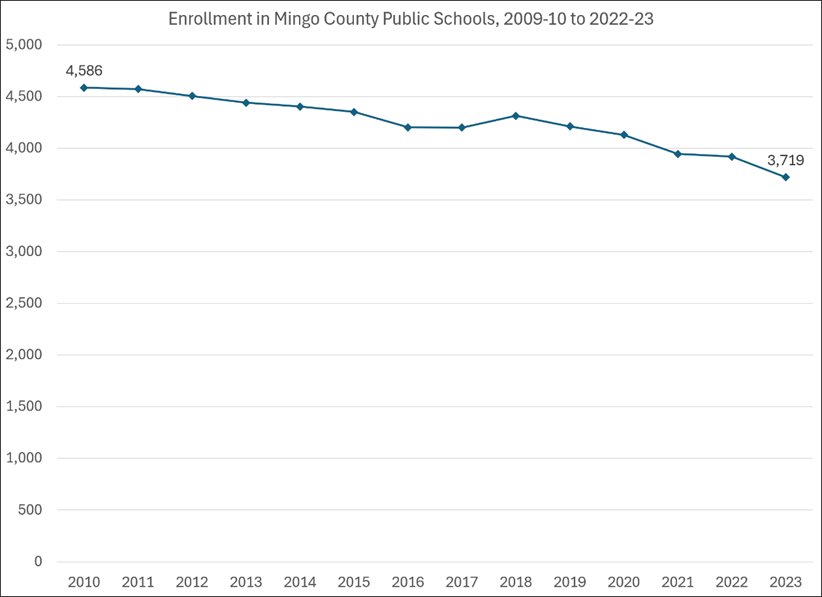
Source: U.S. Department of Education, National Center for Education Statistics
Across nearly three decades of national data, the evidence that private school choice increases closure risk is at best weak and inconsistent, with no significant pattern for rural schools. Where effects do appear, they tend to emerge years after adoption, giving districts time to adapt.
The question, then, shouldn’t simply be whether enrollment is changing. It should be whether district leaders are using the time and resources they have to plan for that change well.
This was originally published on our Substack.
Latest from the Blog
-

New Report: Educational Freedom Grew and Test Scores Improved
Arkansas’s educational choice program got bigger, and the average test performance of the students got better.
-

Missouri Tried to Equalize Charter School Funding: It Did Not Succeed
Massive infusions of funding will not magically make schools better.
-

When It Comes To Choosing Schools, Families Are Mixing It Up
Families are choosing a type of school for one child while choosing a different type of school for another child, in the same household.