
Missouri Tried to Equalize Charter School Funding: It Did Not Succeed
As a born-and-bred Kansas Citian, I know three things: it’s Missouri, not Kansas; barbecue sauce needs molasses; and massive infusions of funding will not magically make schools better.
I thought of the third when I read Andrew Camp, Collin Hitt, and David Griffith’s new paper on funding reforms to Missouri’s charter schools. Missouri is no stranger to school funding issues. The notorious, long-running Missouri v. Jenkins court case shaped school finance in Kansas City for decades. I have probably recommended Complex Justice, Josh Dunn’s magisterial book on the case, more times than just about any other education book.
It appears that Missouri still has education finance problems, this time related to charter schools. (By the way, if you’re interested in the ins and outs of charter schooling in Kansas City, I wrote a long piece about it for the R Street Institute back in 2020.)
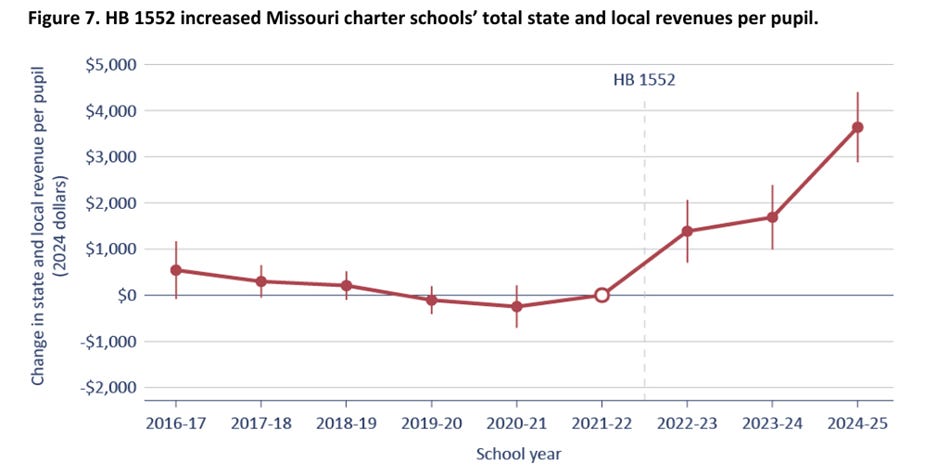
It’s a relatively well-known issue nationwide that charter schools are funded at lower levels than traditional public schools, and Missouri was no exception. In 2022, however, the state legislature passed HB 1552, a provision that would top up charter funding in the hopes of creating closer parity to public schools. Camp et al’s paper looks to measure what happened and whether the law’s goals were met.
They were, sort of.
HB 1552 pretty dramatically increased charter school funding in Missouri. Here is a figure from the paper depicting the changing level of support.
But was that enough to bridge the gap? In order for the gap to close, per pupil aid in traditional public schools would either need to shrink, stay the same, or grow at a slower rate. That is decidedly not what happened. Here is another figure that depicts what did.
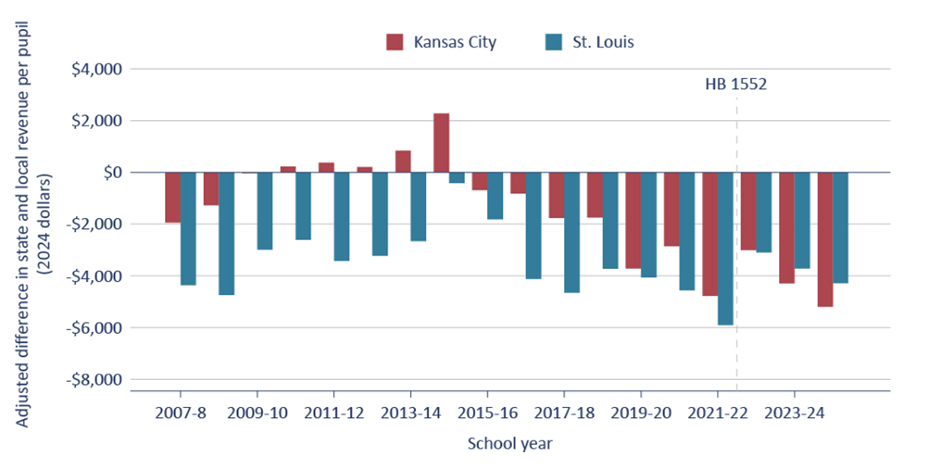
It turns out that traditional public schools keep getting more and more money per student. Even with large increases in funding, charter schools cannot keep up.
This divide persists for a couple of reasons. First, Missouri has a ridiculous funding formula that allows districts to calculate their local property tax revenue for the purpose of state support using valuations from 2005. So even though, as the authors point out, property tax revenues are up 58% in St. Louis and 93% in Kansas City, the state provides funding as if that has never happened. The districts keep all of that new local revenue, massively increasing what is available for students. What’s more, Kansas City and St. Louis (the two districts in the state that have charter schools within their boundaries) have shrinking student populations. All in all, they receive more and more money to serve fewer and fewer students.
The grand total: after HB 1552’s changes, charter schools in Missouri went from being funded at 25-30% less than traditional public schools to around 20% less than traditional public schools.
So, the law failed to meet its goal. What are the next steps? It’s not an easy question. The authors conclude that trying to close the funding gap with districts that have a weird, one-way ratchet of revenues would make the state’s contributions balloon in ways that are completely unsustainable.
Missouri needs to dramatically overhaul its funding formula, but there has been little appetite in the state to do it. It’s possible that costs are going to keep spiraling upward until something breaks.
Those looking at reforming school spending in Missouri would be wise to learn from the state’s history. As Dunn writes at the conclusion of Complex Justice (talking about the Kansas City Missouri School District and referencing Judge Russell Clark, the federal judge who oversaw Missouri v. Jenkins and Arthur Benson, a lawyer for the plaintiffs in the case):
“The KCMSD’s educational problems were not fundamentally monetary. A quick glance at the district’s per-pupil expenditures demonstrates this. In the 1996–97 school year, the district spent $9,407 per student. Adjusted for cost of living, this amount exceeded the per-pupil expenditures of any of the nation’s 280 largest school districts—a point that Judge Clark belatedly and angrily made in his final ruling. The KCMSD’s problems were much deeper than a lack of funds. Arthur Benson, who admirably has not attempted to whitewash the plan’s failures, admits this. ‘We’ve done the easy and expensive things,’ he commented. ‘What remains now are the relatively inexpensive but extraordinarily difficult things to accomplish and that’s to change how teachers teach and kids learn and buildings are organized and administered.’ Changing teaching methods, school management, and district administration are far more difficult tasks than building new buildings and establishing new programs. These problems are political, conceptual, and organizational, not financial, in nature.”
I’m very glad the authors of this paper took the time to carefully unpick exactly what happened, explain why it happened, and offer some straightforward insights as to what we can learn from it. We can only hope that the good people from the Show-Me State will learn from their experiments in education funding. If history is a guide, they won’t.
This was originally published to our Substack.
Latest from the Blog
-

When It Comes To Choosing Schools, Families Are Mixing It Up
Families are choosing a type of school for one child while choosing a different type of school for another child, in the same household.
-

The Federal Tax Credit Rules Are Here: Here’s What We Know
The wait is over. The U.S. Department of the Treasury has released regulations for the Federal Tax Credit for Scholarships (FTCS), giving states, scholarship-granting organizations (SGOs), donors, and families important new details about how the policy will work when it launches in 2027.
-

EdChoice Welcomes Release of 2027 Regulations for the Federal Tax Credit for Scholarships
The U.S. Department of Treasury released long-awaited rules that will govern implementation of the Federal Scholarship Tax Credit (FSTC), signed into law by President Trump on July 4, 2025.