
What Educational Freedom Makes Possible
The families behind decades of progress
Thirty years can be measured a lot of ways.
At EdChoice, we could measure the past three decades in programs created, laws passed, research published or states that have expanded educational opportunity.
Those milestones matter, but they aren’t the ultimate reason for our work.
The real measure of 30 years is found in happier families, the child who rediscovers a love of reading, the student who finally feels safe at school, the parent who watches a child’s confidence return, or the educator who creates something new because the school families need doesn’t exist yet.
At its heart, educational freedom is personal—it’s about families finding the learning environment where their children can thrive.
Tatiana Cox Lopez saw that firsthand with her daughter Analisse.
Analisse has ADHD and dyslexia and had fallen behind in school. Tatiana described watching her daughter struggle not only academically but emotionally as the pace and structure of a traditional classroom failed to match the way she learned.
After Analisse received Florida’s Family Empowerment Scholarship ESA in 2024, her parents transitioned her to homeschooling and more individualized instruction. Tatiana says her daughter’s academic progress and confidence improved dramatically. Today, she describes Analisse as capable, confident and excited to learn again.
The ESA has “changed our daughter’s life,” Tatiana said. “Our experience has shown us that every child learns differently.”
For Tatiana, the lesson is simple: children learn differently, and families need the freedom to respond accordingly.
Corey Burkehardt’s family in Indiana experienced something similar.
Her children, Vance and Evie, both have dyslexia. Before receiving Indiana Education Scholarships, the family struggled to get them the resources they needed. Vance worried about whether he would make it to high school. Evie worried about what her inability to read would mean for her future.
Their scholarships allowed Corey to build individualized learning plans that included a reading interventionist and tutors, support she says the family otherwise could not have afforded.
The change went beyond academics. Both children developed a new love of reading. Evie put it in words that capture what educational freedom can mean to a child: “I now know how to read books and I don’t have to pretend to read anymore.”
For families like Corey’s, the impact shows up not only in academic progress, but in a child’s confidence and sense of what’s possible.
One of the lessons families have taught us over the past 30 years is that there is no single definition of the “right” education.
For some families, it’s a private school. For others, it’s homeschooling, a charter school, a microschool or a combination of learning experiences built around one child’s needs. Some children do best in their local public school, or in completely unique environments.
In Alabama, Christal Gamble Banks knew early that her son Cash learned differently. He began reading at age 2 and doing square-root calculations at 3. By preschool, the work wasn’t challenging him. His teachers tried to help, but Christal ultimately concluded that the traditional environment couldn’t provide what he needed, and the family turned to homeschooling.
In New Hampshire, Megan and Jonathan Ebba have used Education Freedom Accounts to take a hybrid approach to their children’s education. Their children participate in in-person co-op classes, take à la carte classes at a private school, learn at home and online, and, for their oldest, participate in dual enrollment. Megan said the program enabled their family to afford educational resources that otherwise would have been out of reach.
And sometimes parents and educators don’t just find a better option—they build one.
Jill Haskins, director of Kainos Microschool and founder of the Indiana Microschool Network, described microschools emerging when parents and educators can’t find what children need in existing settings. They are being created in homes, churches, commercial spaces and even on farms.
Running one isn’t always easy. But Haskins explained why she does it: “the kids are worth it.”
Jennifer Wolverton had a similar experience in Alabama. An engineer turned homeschool mom, she went looking for meaningful STEM opportunities for homeschool students in Huntsville and found that many available programs were designed around traditional school schedules. So, she created something for her youngest son. That effort eventually became MARS Microschool, where students now encounter robotics, artificial intelligence, writing and other learning experiences.
That, too, is educational freedom: giving educators and parents room not just to choose among existing options, but to imagine better ones.
Over our 30 year history, our research has helped us understand why families make these decisions.
In EdChoice’s 2026 Schooling in America survey, safety was the top reason private school and charter school parents gave for choosing their schools. It was also, by a wide margin, the top reason homeschool parents gave for homeschooling. Among parents who had switched their child’s school type, excessive stress or anxiety was the most commonly selected problem at the former school, followed closely by unmet academic needs and then bullying.
Behind those numbers are families like Tressena Jones’s.
Tressena’s oldest son struggled with bullying. She eventually chose homeschooling, despite worrying about what others would think and whether it would prepare him for his future. Her greater fear, she later said, was leaving her children somewhere they weren’t safe. Her son now aspires to become an engineer.
Or Tonya, a North Carolina mother and educator whose son AJ has special needs. She wanted an environment where he would receive individualized attention and be supported rather than treated like “just another number.” She chose the charter school where she worked because she believed its smaller classes and flexibility could better meet his needs.
These parents aren’t making abstract arguments about education systems. They’re looking at the child in front of them and asking a much more immediate question:
Together with our state and national partners, we’ve made tremendous progress over the past 30 years. When EdChoice was founded in 1996, fewer than 10,000 students participated in private school choice programs. Today, more than 1.5 million students participate in 75 programs across 34 states, plus Washington, D.C., and Puerto Rico.
But there is still so much more to do.
Just under half of America’s K–12 students are eligible for a private school choice program. That means millions more still lack access. And even where programs exist, families don’t always know they’re available. In our 2026 Schooling in America survey, half of parents said they were unsure whether their state even had an education savings account program.
Expanding access is only part of the work. Educational freedom must also be protected. Arizona offers a powerful example: More than 100,000 students are now enrolled in the state’s ESA program, yet proposals have continued to emerge that would significantly curtail the program.
Thirty years have shown us what is possible when families are given greater freedom over their children’s education. The next 30 are about bringing that opportunity to millions more, and ensuring that the choices families already rely on remain available to them.
We’re grateful to the parents who have fought for their children, the educators who have created new possibilities, the students who have shared their stories, and the partners who have worked alongside us to make educational freedom a reality for more families.
Thirty years from now, we hope the story of educational freedom will be told through millions more families whose lives changed because they had the power to choose what was best for their children. Until then, we’ll keep showing up every day to help make that possible.
Latest from the Blog
-
State Audit Finds Incredibly Few Errors in Arkansas’ ESA
When reviewing the $93.8 million Arkansas ESA program for the 2024-25 school year, the state auditor identified $60,417 in anomalous payments. To save you a trip to your calculator app, that’s a finding of 0.06% of total spending that was problematic.
-
“This Is Just a Federal Tax Credit:” Leslie Hiner Breaks Down the FTCS at SPN
We recap remarks made by Leslie Hiner during a private breakfast at State Policy Network’s Annual Meeting about the Federal Tax Credit for Scholarships.
-
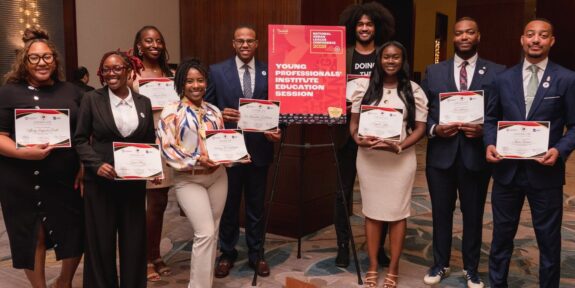
Developing the Next Generation of Education Advocates
We take a look at the Young Professionals Institute: Education Fellowship that is developing the next generation of education advocates.