
Yes, Arizona’s ESA is Open to All
More expensive-to-educate students are not being excluded
Opponents of school choice have long worried that students with disabilities (SWDs) would be excluded from ESA programs because the Individuals with Disabilities Education Act doesn’t apply to private education.
However, it has become increasingly clear to the whole country that families of SWDs are actually one of the most enthusiastic bases of school choice support. Our very, very conservative counts find more than 200,000 students with disabilities using school choice programs right now. That means your average choice kid is at least as likely as a public school kid to be identified with a disability.
Multiple times, both in-person and online, I have seen people move the goalposts in real time. When they learn how the data contradicts their assumptions about SWDs in choice programs, they start making assumptions about what “types” of SWDs are in school choice programs. Surely, they suggest, the “easiest,” “lowest-cost” SWDs are the ones joining school choice programs, while the students with really difficult disabilities remain in public schools
It is true that “disabilities” make up a pretty broad category involving a wide range of needed educational accommodations. Several states that use weighted funding systems grant additional per-pupil funding depending on the severity of the disability. This policy is based on the idea that a student that requires more intense or specialized interventions costs more to educate. Many states aren’t so nuanced, but this trend should still illustrate a recognition that SWDs aren’t a monolith. [1]
In my eyes, the most robust public education funding system providing differentiated aid for SWDs belongs to Arizona, which designates 14 different funding categories based on the student’s specific disability.[2] The most profound cases are entitled to north of $40,000 per student.
As most of the readers here are aware, Arizona also is home to the oldest ESA program in the country. Many newcomers to the school choice conversation are surprised to learn that the Arizona ESA began as a program targeted exclusively to SWDs.
Even today, several years after eligibility was made universal in 2022, a fifth (about 21,000 out of about 103,000) of all of Arizona’s ESA students have disabilities—a percentage that has slightly grown each year after expansion. For context, in Arizona, an ESA student is 56% more likely to have a disability than a public school student (20.6% versus 13.2%).
But, returning to the initial question at hand, what is the nature of these disabilities?
I think the simplest way to answer this question is by showcasing the disability data reported by the Arizona Department of Education. I’ll be using the most recently available data for both public and ESA students, which is 2024-25 for the former and Q3 2025-26 for the latter.
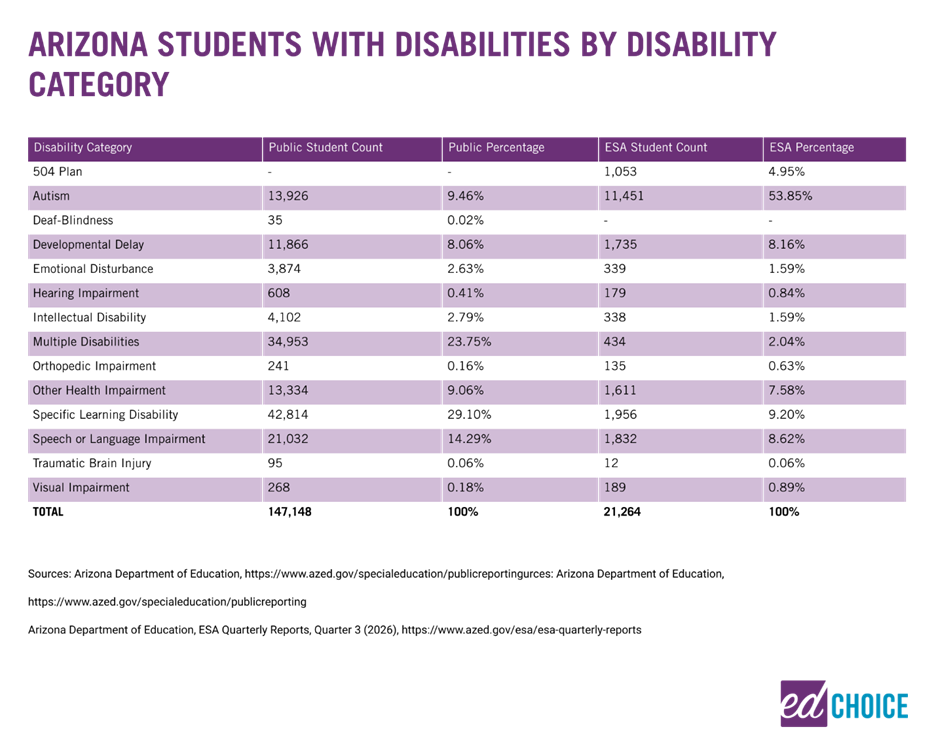
A couple clarifying notes before we continue. First, the ESA data are reported with greater detail, so I combined some categories to reach these numbers. Second, the ESA data include 504 plans, and I have struggled to find comparable 504 plan data for Arizona public schools with any sort of recency. Third, “Deaf-Blindness” is not a category in the ESA data.
What can we learn from this? One point screams particularly loud: autistic students are very heavily represented in the ESA program. More than half of the ESA students with disabilities have this diagnosis. It appears nearly half of all students with autism in the state use the ESA, which is astonishing to me.
There are a few categories where public SWDs outweigh ESA SWDs: “Multiple Disabilities,” “Specific Learning Disability,” and “Speech or Language Impairment.” Speaking as a non-expert in special education matters, the former two categories can encompass a wide variety of circumstances identifying why a child might be struggling in the classroom. Speech or language impairment includes circumstances like stuttering or some voice or language impairment that adversely affects a child’s educational performance.
I don’t see evidence for the idea that the ESA program is just absorbing lower cost or lower severity SWDs. One of the very highest cost categories, autism, is over represented in the program. Some other higher-cost categories are underrepresented, but given how broad and undescriptive they are, it is difficult to determine whether there are any trends in program participation.
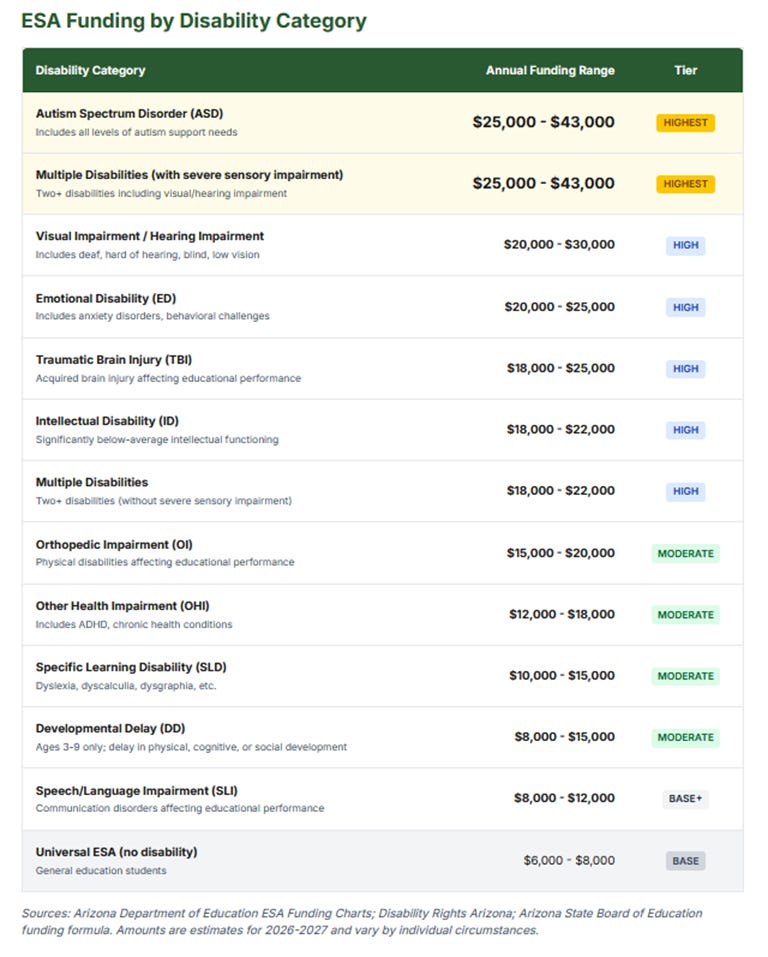
Table by SpecialEd Resource
This is Arizona’s story, and while it doesn’t mean these SWD trends generalize to other school choice states, it does offer at least two policy lessons other states can learn from.
First, ESA funding is connected to the state education funding formula, and ESA students are entitled to both their state base funding and any differentiated funding to which they would be entitled in the public school system. In other words, the funding truly follows the student. Several school choice states only offer flat rate scholarships to students without concern for the severity of their disability. In some special cases, the difference in funding an autistic ESA student would receive in Arizona versus (just to pick on a state) Utah could amount to several thousand dollars.
The alternative, funding all choice students at a flat rate, creates an adverse selection problem. If an ESA program does not account for the additional costs a disability presents, it disincentivizes schools from offering services SWDs might need. It also disincentivizes new, specialized education providers from growing.
And, to reinforce a core point here, these ESA students only receive that additional funding because the state has already determined that they should be entitled to that additional aid in the public school system. If they were not ESA students and were enrolled full time in a public school, they still would be entitled to that money—the state would just direct it to their public school.
Second, a robust supply side helps. Arizona spent more than a decade targeting ESA funds to SWDs. That meant the private special education sector had years to adapt, grow, and get used to the logistics of becoming an ESA vendor. When the expansion took place and word spread about the program, there already was an ecosystem in place to meet the diverse demands of special needs families. Effective ESA administration will recognize that you need a program that education providers want to join.
No one wants an education policy to leave kids with disabilities behind. The notion that ESA programs will do so is currently based on speculation and assumptions and not actual evidence.
Current data from the most established ESA program in the country tells, if anything, the opposite story. Arizona special needs families are selecting into the ESA program at rapid rates, and they are joining in greater numbers year-over-year than families without disabilities. Those disabilities are not generally “low cost,” but given how Arizona’s ESA is set up, that probably isn’t a coincidence.
[1] Note that I am only considering state funding systems here. Historically, federal grants have assisted special education funding, though that money must still be distributed by the states. And many states still rely on local funds to cover most education expenses.
[2] Wyoming is an interesting contender for this title, but they cap funding at the previous year’s total special education spend. Districts cover any extra or unexpected special education expenses.
This was originally published to our Substack.
Latest from the Blog
-

The Federal Tax Credit Rules Are Here: Here’s What We Know
The wait is over. The U.S. Department of the Treasury has released regulations for the Federal Tax Credit for Scholarships (FTCS), giving states, scholarship-granting organizations (SGOs), donors, and families important new details about how the policy will work when it launches in 2027.
-

EdChoice Welcomes Release of 2027 Regulations for the Federal Tax Credit for Scholarships
The U.S. Department of Treasury released long-awaited rules that will govern implementation of the Federal Scholarship Tax Credit (FSTC), signed into law by President Trump on July 4, 2025.
-

Who would vote for school choice?
In our most recent Public Opinion Tracker polling, we asked Americans to think ahead to the next election and consider a hypothetical political candidate who supports ESAs. Then, we asked if they would be more or less likely to vote for that candidate, based on their pro-ESA position.