
Indiana’s 2026 ILEARN State Test Voucher-Participating School Results
The following data was compiled by Dr. Marty Lueken and released by the Institute for Quality Education and EdChoice.
Overview
This memo offers a brief overview of the 2026 ILEARN state test results in Indiana, particularly focusing on comparisons between the public and private school sectors.
In addition to statewide results, this memo includes results for Indiana’s two largest cities, Indianapolis (Marion County) and Fort Wayne. Results are shown for white, Black, and Hispanic students, as well as students classified as receiving free or reduced-price lunch (FRL).
Results for private schools only measure the results from schools participating in the Choice Scholarship Program. Just like public schools, the results for private schools do not specifically measure individual students, or, in this case, students in private schools that receive scholarships. The public school results below only reference schools belonging to traditional public school districts. It excludes public charter schools, education service centers, special education co-ops, state and university run schools, and vocational education co-ops.
Definition of Proficiency
The only outcome variable used in this memo is “proficiency,” that is, the share of a particular group of students performing well enough on the test to meet ILEARN’s standard of “at proficiency” and “above proficiency.” It does not include information on students “below proficiency” or “approaching proficiency.” A student who is “at proficiency” meets current grade level standards is on track for college and career readiness. Please note that ILEARN’s definition of proficiency differs from that of the National Assessment of Educational Progress (NAEP). ILEARN’s “At Proficiency” designation reflects meeting Indiana’s grade-level standards, while NAEP’s “Proficient” designation is a separate achievement standard and should not be interpreted as synonymous with performing at grade level.
Statewide Results

Reading: While racial gaps exist in both sectors, students in voucher participating private schools had higher reading proficiency rates than their public school counterparts in every demographic subgroup. The voucher-public proficiency gap was widest for Black students, at about 15 percentage points. The White–Black proficiency gap was also considerably smaller in voucher schools, about 14 points, compared with 24 points in public schools. The White–Hispanic gap was similar across sectors, at roughly 18 points. Among FRL students, reading proficiency was 40.1% in voucher schools versus 28.8% in public schools, a gap of about 11 percentage points.

Math: Students in voucher participating private schools had higher math proficiency rates than students in public schools (47.2% versus 42.7%). The overall voucher-public gap of 4.6 percentage points was smaller than the reading gap of 7.6 points. The voucher-public math gap was largest for Black students, at about 13 points, compared with roughly 2–2.5 points for White and Hispanic students. Within sectors, the White–Black proficiency gap was considerably smaller in voucher participating private schools, about 17 points versus 28 points in public schools, while the White–Hispanic gap was similar, at about 20 points in both sectors. FRL students also had higher math proficiency rates in voucher schools (38.0% versus 29.6% in public schools), a gap of about 8 percentage points.
Marion County Results
This section includes results for all district and private schools in Marion County participating in the voucher program, regardless of municipality. Public school districts include Beech Grove City Schools, Franklin Township Community School Corporation, Indianapolis Public Schools, MSD Decatur Township, MSD Lawrence Township, MSD Pike Township, MSD Warren Township, MSD Washington Township, MSD Wayne Township, Perry Township Schools, and School Town of Speedway.

Reading: Students in Marion County private schools participating in the Indiana voucher program had higher ILEARN reading proficiency rates than their public school peers in 2026 (42.7% versus 29.8%), a gap of nearly 13 percentage points. The voucher-public gap was largest for Black students, 39.7% reached proficiency in voucher schools compared with 21.8% in public schools, a difference of about 18 points and a rate about 1.8 times as high. Within sectors, racial proficiency gaps were substantially smaller in voucher schools. The White–Black gap was about 6 points in voucher schools versus 22 points in public schools, while the White–Hispanic gap was about 11 points versus 22 points. Among FRL students, reading proficiency was 37.5% in voucher schools versus 24.1% in public schools, a gap of about 13 percentage points.
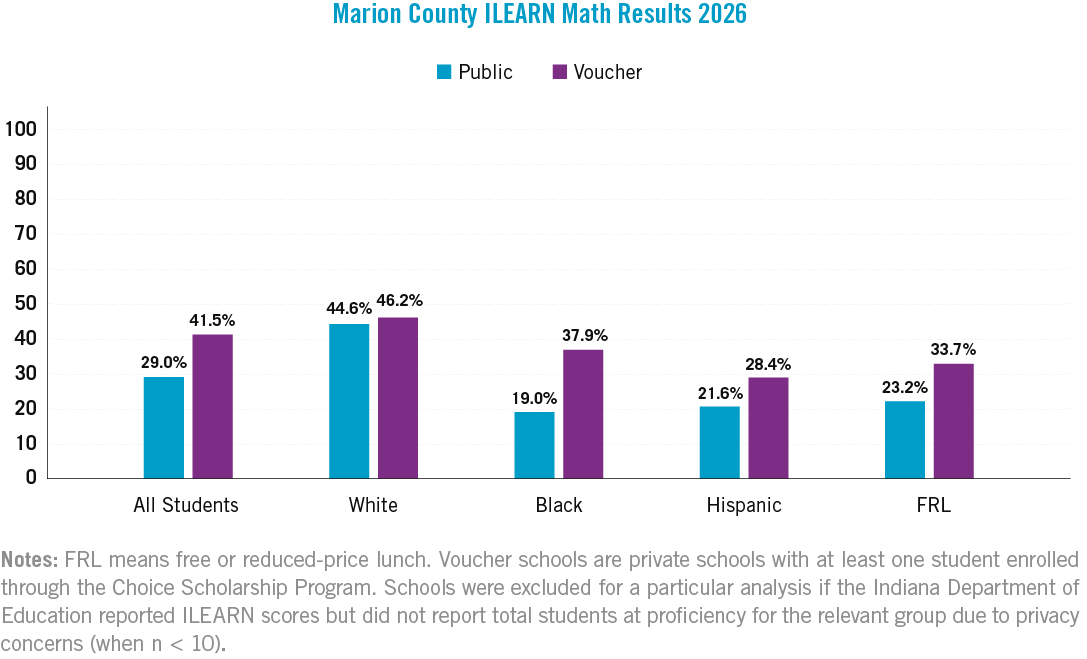
Math: In Marion County, the voucher-public school proficiency gap was similar for math and reading (roughly 13 percentage points in each subject). The voucher-public math gaps for Black and Hispanic students were larger than their statewide counterparts: about 19 points for Black students and 7 points for Hispanic students, compared with 13 and 2.5 points statewide, respectively. Within sectors, racial proficiency gaps were smaller in voucher schools. The White–Black gap was about 8 points in voucher schools versus 26 points in public schools, while the White–Hispanic gap was about 18 points versus 23 points. The voucher-public math proficiency gap for FRL students was about 11 percentage points (33.7% versus 23.2%), somewhat larger than the statewide FRL gap of about 8 points.
Fort Wayne Results
Public schools included in this section’s analyses are those in the Fort Wayne Community Schools district. Included private schools are those that reside in the city of Fort Wayne.

Reading: Students in voucher participating private schools had significantly higher reading proficiency rates than their peers in Fort Wayne Community Schools (52.7% versus 30.0%). The voucher-public gap for Black students was about 16 percentage points, slightly larger than the statewide gap of 15 points. Within sectors, the White–Black proficiency gap was larger in voucher schools, about 32 points versus 25 points in public schools. FRL students in voucher schools also had higher reading proficiency rates than their peers in Fort Wayne Community Schools (37.9% versus 24.4%), a gap of about 14 percentage points.
Hispanic students are not included in the chart, as they are based on only 9–13 tested students per subject and should be interpreted cautiously because of the extremely small sample. However, among students with reported results, Hispanic students’ proficiency rate actually exceeded White students’ rate in voucher schools (69.2% versus 65.9%).

Math: Students in voucher participating private schools had higher math proficiency rates than their peers in Fort Wayne Community Schools across every demographic group. The voucher-public gap for Black students was about 30 points and White students about 21 points. Within sectors, the White–Black proficiency gap was smaller in voucher schools, about 19 points versus 28 points in public schools. Among Black students, math proficiency rates were higher than reading rates in voucher schools and slightly lower in public schools. Among FRL students, math proficiency was 45.3% in voucher schools versus 23.0% in Fort Wayne Community Schools, a gap of about 22 percentage points, considerably larger than the FRL reading gap of about 14 points.
Hispanic students are not included in the chart, as they are based on only 9–13 tested students per subject and should be interpreted cautiously because of the extremely small sample. However, among students with reported results, Hispanic students’ reported proficiency rate was 76.9 percent, which was almost 54 percent higher that Hispanic students in public schools. Hispanic math proficiency actually exceeded White students’ rate by about 13 points in voucher participating private schools.
Top-ranked Schools
The table below represents the 25 highest-performing Indiana schools in terms of combined reading and math ILEARN proficiency rates. Private schools are labeled in green for ease of reference.

Of the top 25 top schools by reading and math combined proficiency rates, 10 schools participated in the voucher program. Only schools with a minimum of 25 tested students were included in this list. (This inclusion rule dropped Saint Aloysius Catholic School (Diocese of Fort Wayne – South Bend) from the rankings, which tested only 21 students and had a 76.2% proficiency rate.)
Latest from the Blog
-

Gifted, Talented, and Switching Schools
We’ve surveyed parents about advanced/gifted education off and on since 2023, using our Public Opinion Tracker. Here is what we learned.
-
This Is What Passing an Education Bill Feels Like
EdChoice Academy brings the challenges of passing state education legislation to life through an interactive simulation.
-

EdChoice Legal Advocates Wins Major Victory Defending Tennessee School Choice Program
EdChoice secured a major victory for Tennessee families Monday when a three-judge panel dismissed a lawsuit challenging the state's ESA.