
Declining Enrollment Doesn’t Have to Mean Declining Schools
With thoughtful right-sizing, districts can protect students, improve programs, and become more resilient
Since the Covid pandemic, school officials have warned about declining enrollment and a looming fiscal cliff. Those concerns are real. The U.S Department of Education projects that enrollment for public elementary and secondary schools will decline by 2.7 million students, or by about 5.5%.
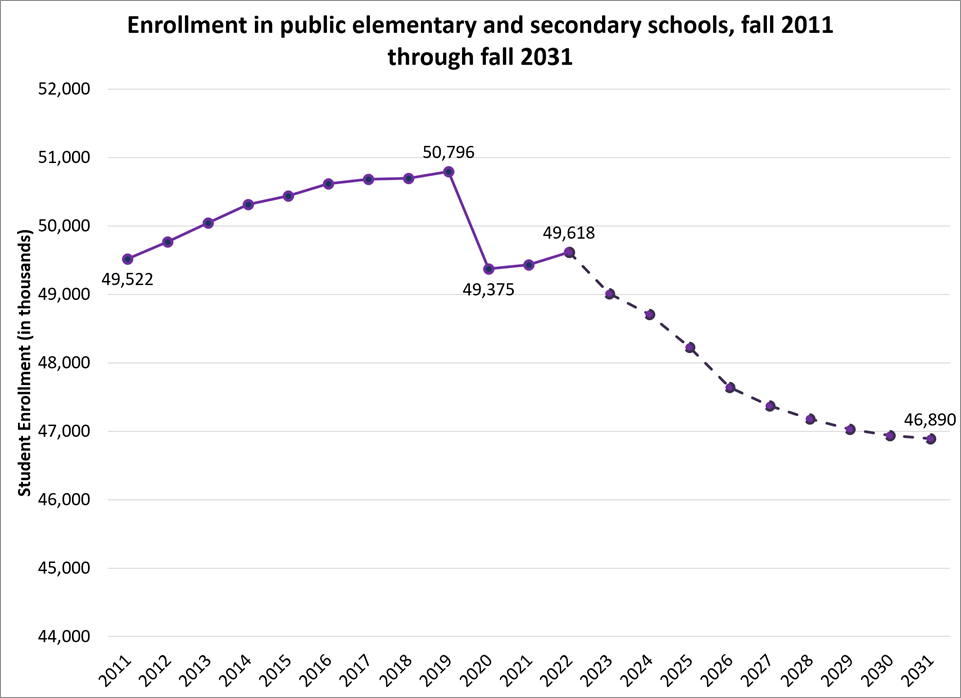
When enrollment falls, districts may receive less funding while still operating the same number of buildings, bus routes, and programs. Closing or consolidating a school can disrupt families, lengthen commutes, and affect communities that view their schools as neighborhood anchors.
District leaders will face difficult decisions. But difficult does not mean impossible, and it does not excuse failure.
Public school systems have managed demographic change for decades. They opened schools when enrollment grew, redrew attendance boundaries as populations shifted and consolidated buildings when communities shrank. The task now is to manage the latest transition in ways that leave students better served.
Two Sectors, Two Fiscal Realities
The pandemic highlighted an important contrast between public and private education.
While many public school systems remained remote, private schools often went to great lengths to reopen their classrooms. A national survey conducted in late 2020 found that 60 percent of private school students were receiving full-time, in-person instruction, compared with 24 percent of students in traditional public schools.
Private schools had a strong incentive to respond: They operate in a world of scarcity. When students leave, tuition revenue generally leaves with them. They must attract families, meet their needs, and adjust operations when enrollment changes.
Public school systems operate under a different fiscal model. State and local funding systems frequently cushion districts from the immediate financial effects of losing students. During the pandemic, Congress added an extraordinary layer of support by appropriating nearly $190 billion in federal relief through the Elementary and Secondary School Emergency Relief (ESSER) Fund.
The lesson should not be that either sector is inherently superior. It should be that America needs an education system across sectors that is responsive and resilient. Schools were not prepared for the last emergency. The question is whether they will be better prepared for the next one.
Fewer Students, More Revenue
While ESSER funding has expired, that does not mean public education has been starved of resources.
Public school spending per student has increased substantially over time, over and above inflation. The long-run trend has been one of rising investment, even as school-choice programs have expanded.
NCES data extend that story through fiscal year 2024.
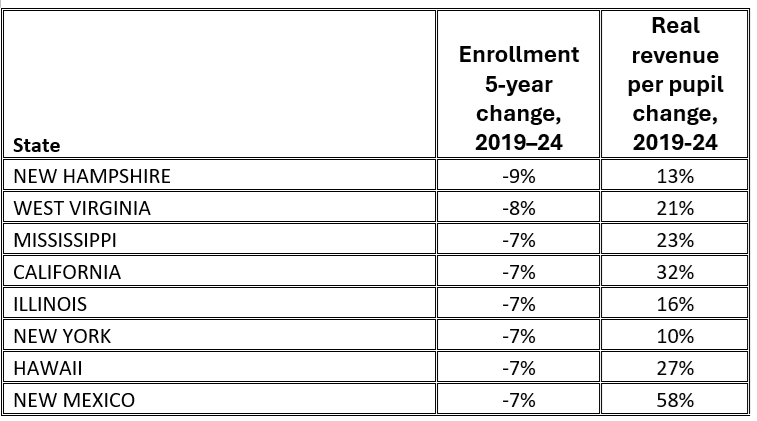
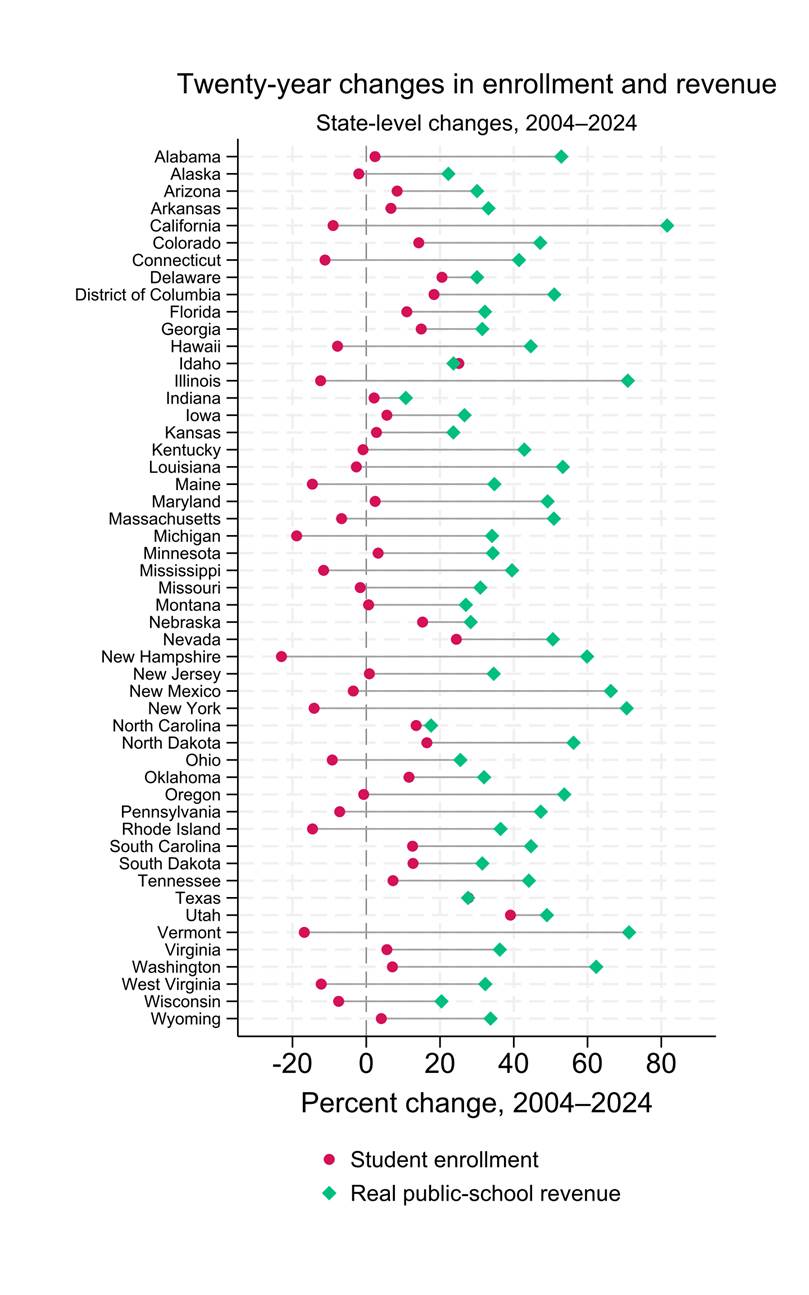
Nationwide public school enrollment fell 3 percent between 2019 and 2024, from 50.6 million students to 49.3 million. Yet inflation-adjusted revenue (all sources) per student increased 16 percent, from $18,213 to $21,065. Over the longer period from 2004 to 2024, enrollment grew only 2 percent while real revenue per pupil increased 43 percent.
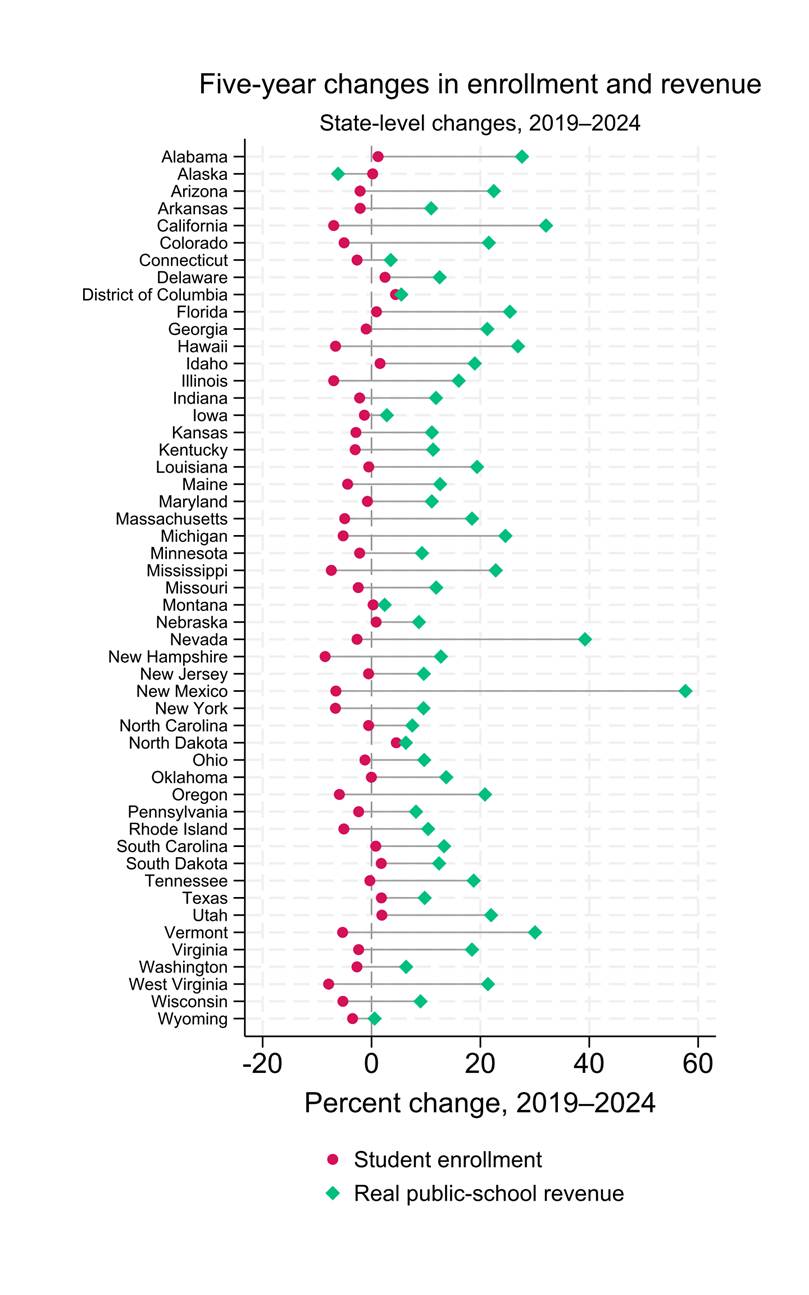
The pattern is widespread. Between 2019 and 2024, enrollment declined in 36 states and the District of Columbia. Yet real revenue per student rose in every jurisdiction except Alaska. Over the full 20-year period, 22 jurisdictions lost students, while every one of them experienced an increase in inflation-adjusted revenue per pupil.
The charts at the end show these patterns for each state. In almost every case, the change in funding was greater than the change in enrollment.
These patterns mean there are more resources available for students in district schools on a per-student basis today compared to before the pandemic.
Sources: U.S. Department of Education, National Center for Education Statistics; U.S. Bureau of Economic Analysis, Personal Consumption Expenditures: Chain-type Price Index [PCEPI], retrieved from FRED, Federal Reserve Bank of St. Louis; https://fred.stlouisfed.org/series/PCEPI
To be sure, this does not mean every district is flush with cash. Statewide averages can mask difficult local conditions, and declining enrollment may be concentrated in particular districts or neighborhoods. It does mean that enrollment decline and funding decline are not the same thing.
But, you might be asking, how can it be true that districts with fewer students receive more money? Isn’t funding linked to enrollment?
Most states provide funding protections such as hold-harmless guarantees, declining-enrollment adjustments or multiyear student-count averages. These protections give districts time to adjust instead of forcing them to absorb enrollment losses all at once.
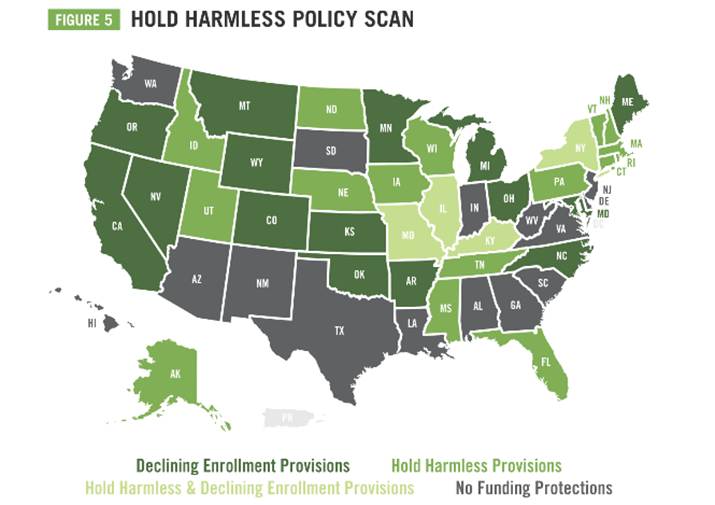
Declining enrollment protections are meant to help districts adjust to enrollment losses by limiting the immediate effect on their budgets. For example, when a district’s enrollment falls, the state may calculate funding using enrollment from prior years rather than the lower current-year count.
Funding guarantees, often called hold-harmless provisions, ensure that a district receives at least a specified minimum amount of funding. For example, a provision may guarantee that a district receives no less state aid than it received in a specified prior year.
Right-Sizing Done Right
The goal of right-sizing, instead of simply cutting costs, should be to organize resources around the students who remain.
Districts can begin by using realistic enrollment projections rather than assuming students will return. They can reduce staffing gradually through attrition, consolidate administrative functions, reconsider transportation routes, and avoid committing temporary money to permanent expenses.
Facilities require particular attention. Operating half-empty buildings can consume money that could be deployed more strategically (e.g., support for teachers, counselors, tutoring, advanced courses, or career programs). But closures should not be based on enrollment alone. Districts should consider academic quality, building condition, geography, transportation, and the effect on vulnerable students. And closures need not be the only option to solve issues with unused space.
As one of us wrote previously, the growth in educational supply we’re starting to see in states with broad choice programs can present an opportunity for how districts handle unused space.
“This growth in educational supply could be especially beneficial for under-enrolled districts with empty spaces by leasing classrooms to new education providers that emerge in response to ESA-driven demand, districts can make effective use of their resources while fostering educational innovation.”
Right-sizing is painful when it is reactive, opaque, and driven by across-the-board cuts. But it can be productive when it is transparent, gradual, and centered on students and educational quality.
Choice Isn’t to Blame
School choice opponents often attribute enrollment losses to vouchers, education savings accounts, or other alternatives. But choice is only one part of a much larger demographic story involving lower birth rates, population migration, homeschooling, and changing family preferences.
As we have written, the claim that choice is draining public education does not fit the broader fiscal evidence. Public school systems have continued receiving more resources per student even as choice has expanded.
The answer to enrollment change is not to insulate institutions permanently from changing reality. And it’s also not to celebrate disruption for its own sake.
The goal should be a sector-agnostic education system in which funding supports students, dollars follow students, and schools respond to families. That will create a more resilient way to deliver K-12 education for all families.
Declining enrollment presents real challenges. It also gives district leaders a chance to build stronger schools for the students they serve.
This was originally published to our Substack.
Latest from the Blog
-
This Is What Passing an Education Bill Feels Like
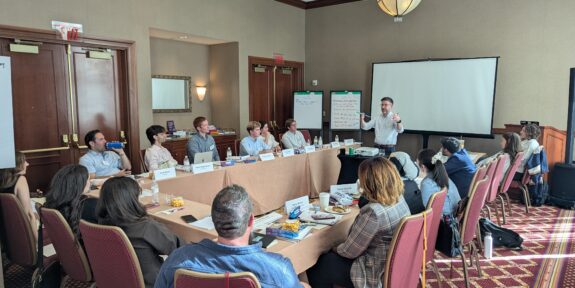
EdChoice Academy brings the challenges of passing state education legislation to life through an interactive simulation.
-

EdChoice Legal Advocates Wins Major Victory Defending Tennessee School Choice Program
EdChoice secured a major victory for Tennessee families Monday when a three-judge panel dismissed a lawsuit challenging the state's ESA.
-

Teachers Support Federal Tax Credit, Prioritizing Education Issues As Midterms Approach
A new survey explores teachers' views on the Federal Tax Credit for Scholarships, education priorities ahead of the midterms, and more.