
Let’s Not Fail the Pandemic Generation Twice
Last week, the National Center for Education Statistics published the 2025 results of the long term NAEP assessment for nine and 13-year-olds. This test, given to a representative sample of students in math and reading since the early 1970s, provides one of the best long-term measures of student performance that we have.
The general story of NAEP (and other standardized test score) results is that scores rose from the 1970s until around 2012 only to decline since, further accentuated by post-pandemic drops. This has been termed the “learning recession.”
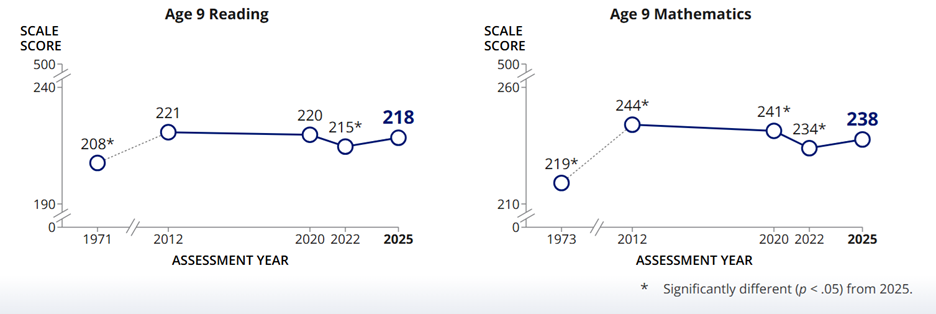
The long-term results illustrate these trends. Using scale score points, nine-year-olds rose in reading from 208 points in 1971 to 221 points in 2012, only to decline to 215 points in 2022 before (partially) recovering to 218 points in 2025. The story is similar in math, rising from 219 to 244 points before dipping to 235 and finally rising back to 238.
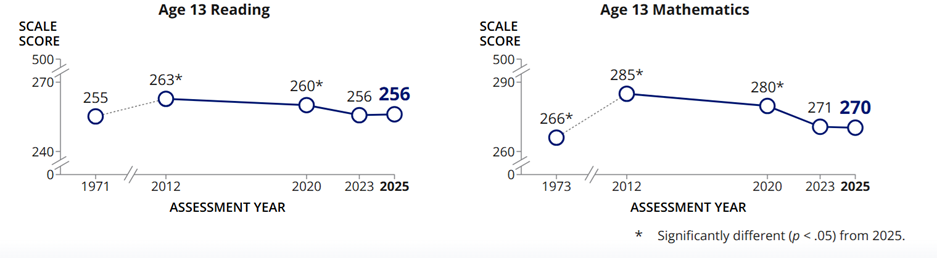
We can follow a similar pattern for 13-year-olds—with one key difference. In reading, scores rose from 255 in 1971 to 263 in 2012, only to dip to 256 in 2023. Their scores did not increase in 2025. Mathematics tells the same story. Scores rose from 266 to 285, only to fall to 271 and actually drop one point from 2023 to 2025, ending up at 270.
Before I offer some interpretation, it is important to underscore what, or perhaps more importantly who, the long-term NAEP measures. It looks at a snapshot of students at those ages in school; it does not follow the same cohort of students over time. So, the test looked at students who were nine in 2012, and then a totally different set of students who were nine in 2020, etc. Sometimes, when people talk about these scores “going up” or “going down” they speak as if it is the same students changing their educational achievement over time. That is not the case. They are separate cohorts.
With that out of the way, a couple of quick reactions.
First off, we have made much more progress improving educational achievement of nine-year-olds than thirteen-year-olds.
Even taking into account dips post-2012, scores for nine-year-olds are up 10 points in reading and 19 points in math since 1970. On the other hand, scores for thirteen-year-olds remain flat, only up a single point in reading and four points in math after more than 50 years. In reading, scores for 13-year-olds didn’t really change much over time, with the low point and high point only eight points apart. The real story is the cratering in math. From 1971 to 2012, scores rose 19 points, only to fall 15 points from 2012 to 2025.
Second, America is not alone in its learning recession.
Inevitably, when NAEP scores are released, advocates like to use them to argue for or against changes in American education policy. Given that scores peaked at a particular point in time, observers have pointed to different changes in American education policy that took place in the early 20-teens, from the cessation of accountability programs to the Common Core. But there is one complicating factor: scores are dropping all over the world. Here is a chart looking at PISA scores for the last 20 years. (PISA tests are assessments in reading, math, and science administered by the OECD to 15-year-olds in dozens of countries every three years).
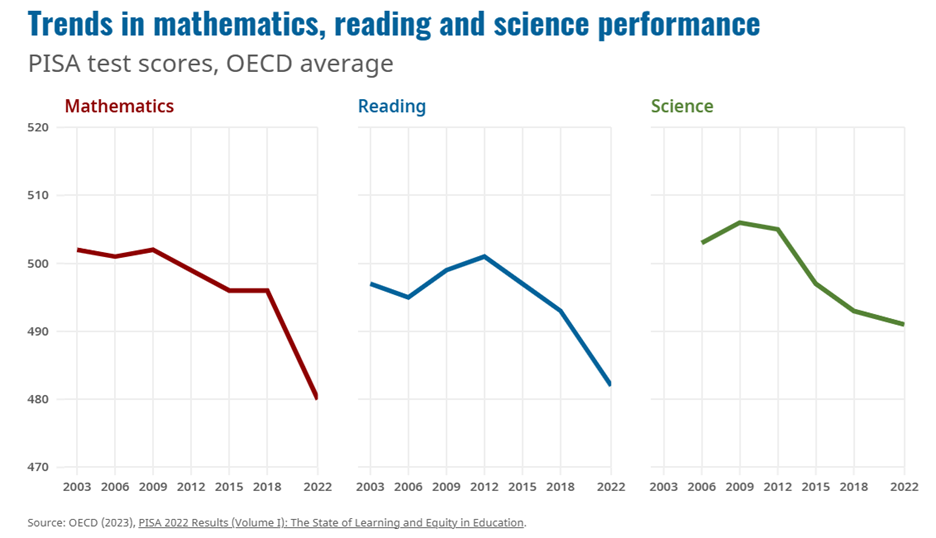
France didn’t use Common Core standards and there was no “No Child Left Behind” in Spain. It is tough to pin learning losses on anything in particular that the US did when nations all over the world experienced similar patterns of “learning recessions.” We’re going to have to look to broader phenomena to try and explain these trends.
Third, the pandemic was bad.
Really going out on a limb there, I know, but seeing the divergence between nine-year-olds and thirteen-year-olds makes the case quite stark. Nine-year-olds in 2025 were generally spared the worst of the pandemic, because they were in pre-K or not in school at all during the height of it. Thirteen-year-olds on the other hand lived through the disruptions of the pandemic during some of the most formative parts of their early schooling years. Seeing scores for nine-year-olds meaningfully tick upward in 2025 shows that the drop for the COVID cohort was just that—a drop for a single cohort of students, not a permanent change in student achievement. But today’s thirteen-year-olds continue to feel the effects of the pandemic. Their scores are not heading back upward.
Looking at these results, I get a real glass half empty or half full feeling.
The positive story is that it appears that the pandemic’s damage might be limited to a particular cohort of students. If we look at nine-year-olds, the test score trends are moving in the right direction. There is still a way to go before the post-2012 dip is entirely erased, but it is better to be rising than falling.
The negative story is the long-term damage done to the pandemic cohort of students. I worry that the damage being isolated to a single subset of students will lead to excusing their struggles or sweeping them under the rug. Oh you know how they are, they were in second grade during the pandemic. And then schools just move on to the students who weren’t as badly harmed. That cluster of students is going to go on to high school, and then they’ll enter college and the workforce in only a few short years. It is a ticking time bomb to have one age group systematically less able to read, write, and do math. If opportunity passes them by, I can’t imagine they’re going to be happy about that.
There are many positive things happening in American education. Educators and policymakers seem to have coalesced around better methods of teaching reading. Attention is turning to evidence-based approaches to math. Huge expansions in school choice should help students sort into schools that will better meet their needs and improve their abilities.
To many students were failed during COVID. Let’s not fail them again.
Latest from the Blog
-

This Is What Passing an Education Bill Feels Like
EdChoice Academy brings the challenges of passing state education legislation to life through an interactive simulation.
-

EdChoice Legal Advocates Wins Major Victory Defending Tennessee School Choice Program
EdChoice secured a major victory for Tennessee families Monday when a three-judge panel dismissed a lawsuit challenging the state's ESA.
-

Teachers Support Federal Tax Credit, Prioritizing Education Issues As Midterms Approach
A new survey explores teachers' views on the Federal Tax Credit for Scholarships, education priorities ahead of the midterms, and more.