
Who would vote for school choice?
Polling shows how Americans perceive pro-ESA candidates
School choice has a long history as a partisan issue—especially once the word “voucher” enters into the mix. But a lot has changed in the past few years.
Vouchers have continued to grow in terms of participation numbers, but they’ve been eclipsed by the sheer number of students participating in education savings account (ESA) programs. That’s remarkable, considering that ESAs were a blip on the radar before 2020. The numbers are 774,299 ESA students to 433,230 voucher students, if you’re curious. (You can check my math here.)
All of this to say, ESAs are an entirely different ball game in terms of political and public perception. The term “ESA” hasn’t (yet) transformed into a divisive buzzword. At least, certainly not to the same extent.
So, can ESAs win the battle of public opinion? How about in elections?
In our most recent Public Opinion Tracker polling, we asked Americans to think ahead to the next election and consider a hypothetical political candidate who supports ESAs. Then, we asked if they would be more or less likely to vote for that candidate, based on their pro-ESA position.
About one-third of Americans (32%) said that they’d be more likely to vote for a candidate who supports ESAs.Another third (36%) said it would make no difference either way. The remaining respondents were mostly undecided or had no opinion. Only 6% of American adults were less likely to support a pro-ESA candidate.
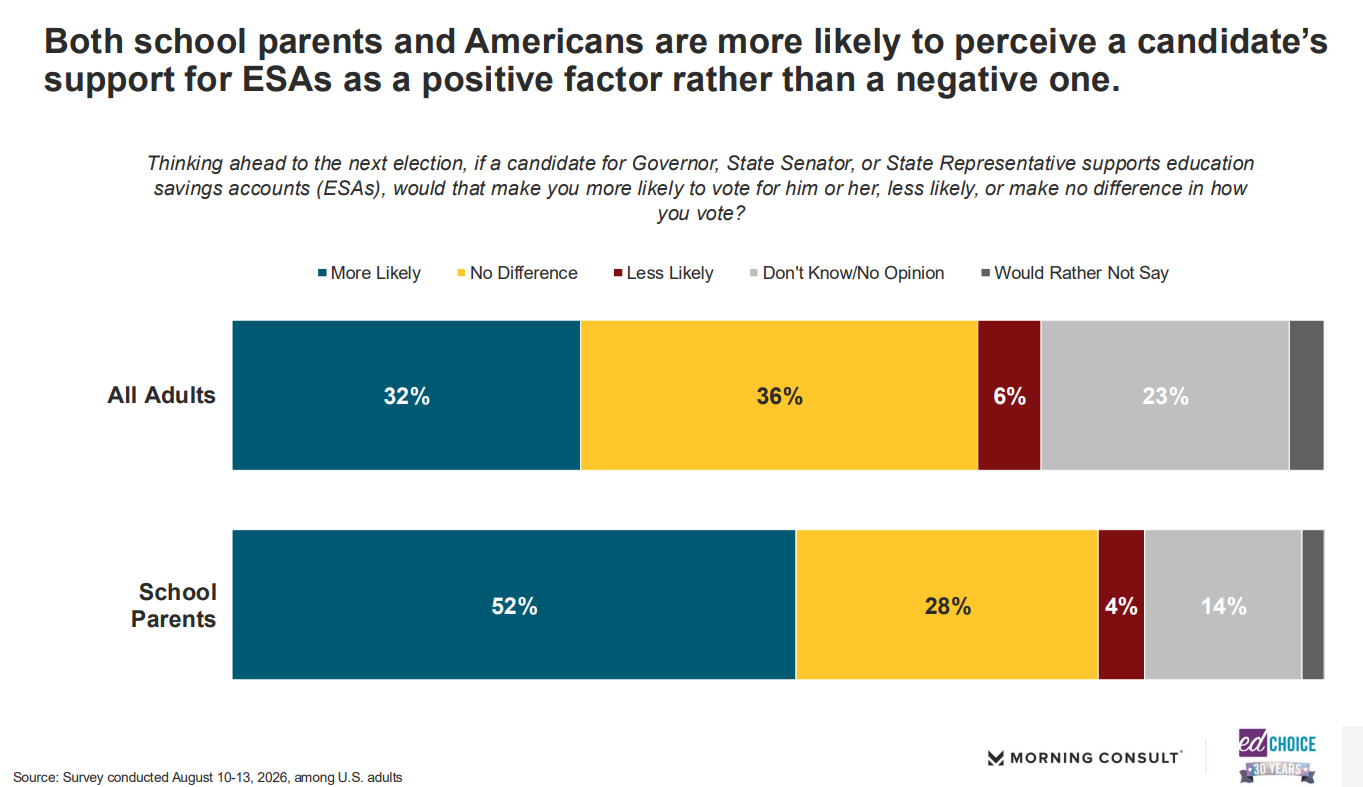
That last data point stood out to me. Very few people had a negative reaction to a candidate supporting ESAs. In fact, across all the demographics we include in our polling, the highest that “less likely to vote for” number ever reached was 9% (among union members).
Another interesting angle we can examine are the demographics of respondents who were most likely to vote for a candidate based on their ESA support. School parents are at the top of that list, with 52% saying they’d be more likely to vote for a pro-ESA candidate (and only 4% being less likely). Parents directly stand to benefit from an ESA system and generally show high levels of support for various school choice policies, so that’s unsurprising.
From there, the list gets less predictable. The next highest group was LGBTQ respondents, at 47%. Other groups showing high support include: Black adults, Hispanic adults, Gen Z, Millennials, and union members. In each group, about 40-43% said they’d be more likely to vote for a candidate who supports ESAs.
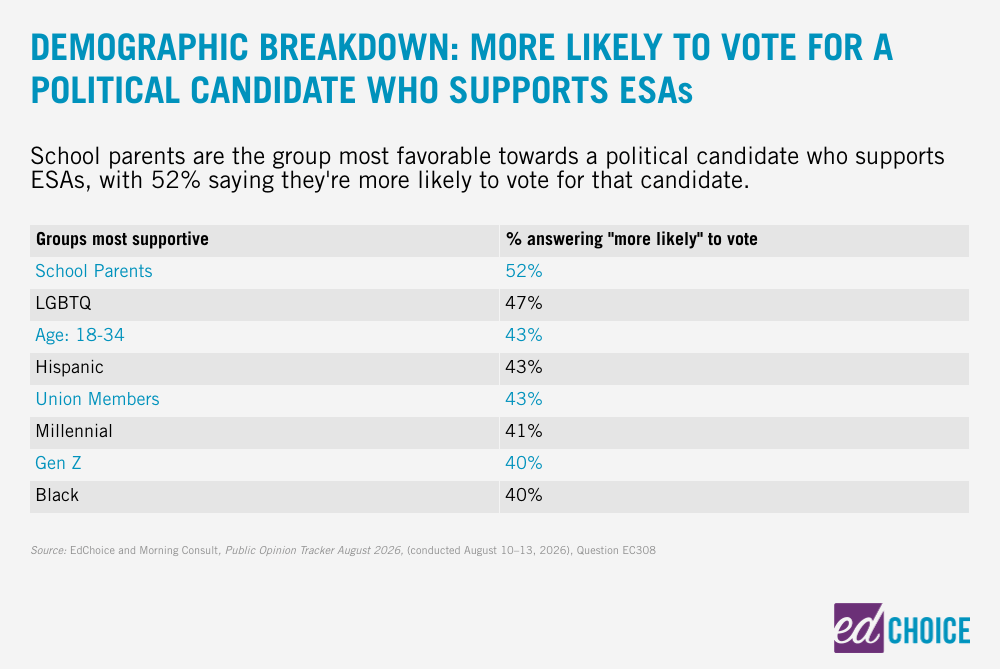
What’s striking about this table is what’s missing from it. Republicans and conservatives, two groups traditionally supportive of school choice, don’t make the top ten. In fact, Republicans and Democrats don’t differ much on this question—34% of Republicans said they’d be more likely to vote for a pro-ESA candidate, compared to 38% of Democrats.
Seeing that party comparison on a school choice issue feels a bit like entering the twilight zone, but it’s great news. The lack of a partisan divide sends a hopeful signal that ESAs haven’t become a divisive wedge issue. Democrats aren’t less likely to vote for a pro-ESA candidate. Perhaps ESAs can be a form of school choice that reaches across the aisle.
Overall, the main takeaway here is that Americans are much more likely to see a political candidate supporting ESAs as a positive factor rather than a negative one. Most people view a pro-ESA stance in a positive or neutral light. As we go into election season, that’s something to keep in mind. As it turns out, a lot of people would vote for school choice.
This was originally published on our Substack.
Latest from the Blog
-

EdChoice Urges Supreme Court to Review California Religious Freedom Case
This week, EdChoice Legal Advocates (EdLA) filed an amicus brief with the U.S. Supreme Court, expressing support for religious families seeking to use faith-based curricula in California’s independent study program.
-

New Survey: Back to School and Election Season
As a new school year begins and midterm elections approach, new EdChoice polling reveals what Americans and school parents think about the biggest issues facing K–12 education—and what they’re prioritizing in the year ahead.
-
Does School Choice Cause Public Schools to Close?
Does school choice cause public schools to close? New research examining nearly three decades of data finds little evidence that it does—even in rural communities. Instead, closures are more closely tied to broader enrollment and demographic trends.