
Yes Mr. Secretary, School Choice Serves Students with Special Needs
You want data? We’ve got data.
Last week, friend of Informed Choice Rick Hess hosted an event at the American Enterprise Institute titled “What Are Democrats for in Education Reform?” It featured Jorge Elorza, CEO of Democrats for Education reform and former mayor of Providence, Rhode Island, Ravi Gupta and Nicole Pollock, also of DFER, and former Secretary of Education Arne Duncan.
It was an interesting conversation, but I want to highlight a brief exchange that takes place around the 40-minute mark of the video, when Rick asks Sec. Duncan about his views on vouchers (this matters because DFER has been much more open to private school choice than many other Democratic organizations).
Here is the transcript:
Rick Hess: Is still that you don’t think vouchers work?
Arne Duncan: I want to see data that shows me that kids with those vouchers are getting a better education. I’ve never seen that. I want to show data showing that you’re taking…
Rick Hess: Well, some of our friends at EdChoice, I suspect, will be emailing you after this.
Arne Duncan: I’m happy to learn and happy to be corrected. I want to see that they are going to kids with special needs. I want to see that they’re not just going to wealthier kids in places like Florida, middle class, subsidizing middle class. So, I’m all, What are we doing for low-income kids? What are we doing for first generation? What are we doing for English language learners? Show me that. And I and I have not seen anything at scale that shows effectiveness there.
Rick Hess: Yeah. So So Pat Wolf, University of Arkansas, is going to fill up your inbox.
There is a lot there, and of course we’d direct Secretary Duncan to our 123s of School Choice that summarizes 197 studies of choice across a variety of metrics.
But there is one particular area that Secretary Duncan raised, and raised first, that has some new research out directly addressing the question. That is the prevalence of students with special needs in private school choice programs.
Pat Wolf, who Rick mentioned, along with my colleagues John Kristof, Alex Wolf, and Alli Aldis have a new paper out with AEI that estimates the number and proportion of students with special needs participating in private school choice programs.
Here is the key figure:
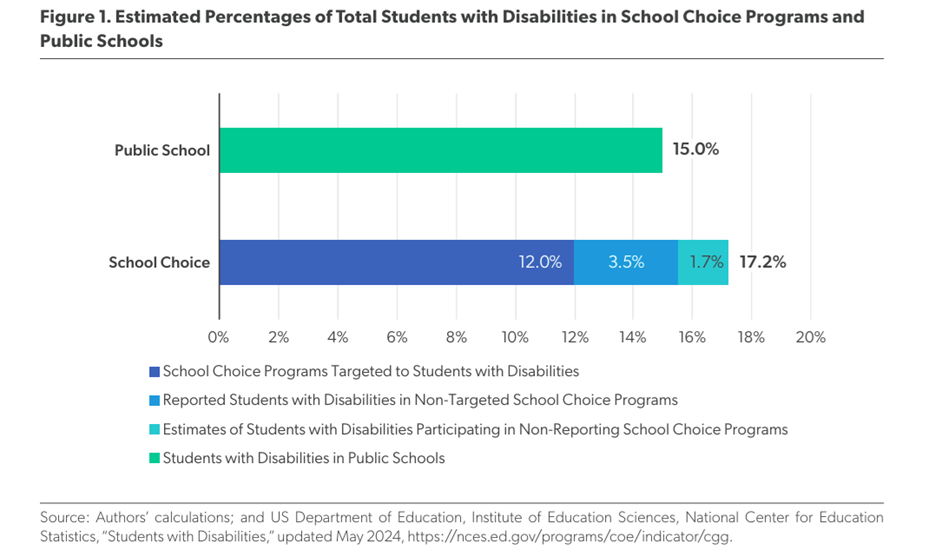
Yes, you are reading that correctly. Private school choice programs serve a higher percentage of students with identified special needs than traditional public schools.
So not only are private school choice programs not neglecting students with special needs, they are actually serving more of them.
Part of what explains this is that there are several large programs specifically for students with special needs. But other, universal programs also have high participation rates for students with special needs.
A quote from the paper:
“Arizona’s Empowerment Scholarship Accounts ESA program enrolled 21,264 students with disabilities, composing almost 21 percent of program participants in 2025–26. Nearly 36 percent of the students in the Arkansas Education Freedom Accounts ESA program in 2024–25 had disabilities, while that proportion was 7.4 percent in Indiana’s school voucher program and 9.5 percent in Maryland’s Broadening Options and Opportunities for Students Today (BOOST) voucher program. The Education Freedom Accounts program in Texas, the largest day-one school choice program ever, recently launched with nearly a quarter of its students verified as having a disability.”
How can this be?
Careful readers of Informed Choice will remember John’s piece from a few months ago, where he looked at the high rates of participation of students with special needs in the Arizona ESA program and found that even within that population, the ESA program is serving everyone. It is not, as many critics have claimed, shunting more severely disabled or more difficult to educate students out of the program.
Arizona accomplishes this for a couple of reasons. As John argued:
“ESA funding is connected to the state education funding formula, and ESA students are entitled to both their state base funding and any differentiated funding to which they would be entitled in the public school system. In other words, the funding truly follows the student.”
But it isn’t just that, as he put it:
“Arizona spent more than a decade targeting ESA funds to SWDs. That meant the private special education sector had years to adapt, grow, and get used to the logistics of becoming an ESA vendor. When the expansion took place and word spread about the program, there already was an ecosystem in place to meet the diverse demands of special needs families.”
The point here is not to take a victory lap or try and dunk on someone for their views. The point is to say that private school choice programs serve students with special needs because they are designed to do so.
If we want these programs to continue to serve students with special needs, ensuring that the funding that those children need actually follows them is step one. Once that is in place, a laser-like focus on cultivating the supply side is key. Incubating and supporting new organizations and institutions as well as connecting the existing web of providers to families now able to afford them will ensure that options actually exist for those with the new power to choose them.
This was originally published to our Substack.
Latest from the Blog
-

“Study Shows!” The Five Questions You Should Ask When Interpreting Research
How do you decide whether a study measures up to its headlines? We give you five questions to ask yourself.
-

Testing, Testing (and our 123s)
Most education savings account programs require standardized testing, but the results alone may not fully capture student success, parental priorities, or the diverse benefits of school choice.
-

Indiana’s 2026 ILEARN State Test Voucher-Participating School Results
We offer a brief overview of the 2026 ILEARN state test results in Indiana, particularly focusing on comparisons between the public and private school sectors.